
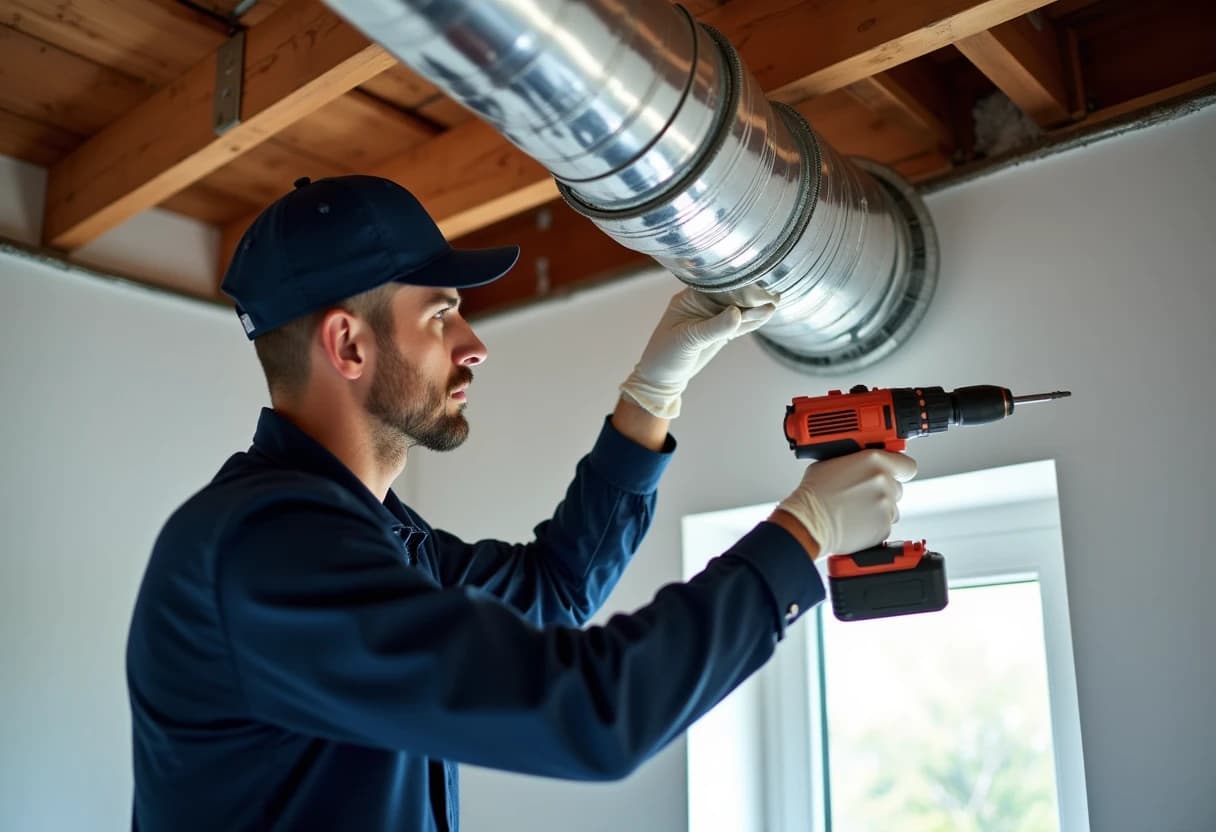
An overlong dryer vent is a permanent tax on every load of laundry. Each foot of duct and every elbow adds resistance; the code caps the total at 35 equivalent feet — with each 90-degree elbow typically counting as five feet — because beyond that, dryers simply cannot push lint and moisture to the outlet. Yet Greater Boston basements are full of runs half again that long, snaking around decades of renovations. Our rerouting service shortens them: we find the nearest legal path outdoors, often cutting a 40-foot wander to a 12-foot straight shot, and rebuild it in rigid metal. Drying times drop immediately, lint accumulation slows permanently, and the fire-risk math improves for good.
Why Dryer Vent Installation & Rerouting Matters for Hanover Homes
Length is the invisible constraint most existing vents violate. A dryer is a modest blower pushing moist, fiber-laden air, and its reach is finite: the code's 35-foot equivalent-length budget shrinks fast when elbows are counted — a typical deduction of five feet per 90-degree bend and two and a half per 45 means a run with four corners has spent twenty feet of budget before its first straight section. Exceed the limit and physics takes over: airflow velocity drops below what carries lint, fibers settle in the duct, moisture condenses instead of exiting, and the system clogs on a schedule no cleaning interval can economically match. This is precisely the condition of countless Greater Boston vents, installed when the laundry moved but routed around, rather than through, whatever stood in the way. Rerouting solves it at the root. Our crews measure the true equivalent length, find the shortest legal path — often through a rim joist or closer wall the original installer ignored — and rebuild. Customers whose dryers limped for years routinely describe the result as getting a new appliance.
Basement laundries dominate Hanover's housing stock, and they are where thoughtful venting matters most. Hanover's housing is dominated by 1960s-through-1990s Colonials, capes and split-entries on generous wooded lots, with a scattering of antique homes around Hanover Four Corners and newer construction near the redeveloped Hanover Crossing. Most of the town was built in the forced-air era, so full duct systems are the norm - and many are now at the thirty-to-fifty-year mark where accumulated debris and loosening joints really start to affect airflow. A below-grade dryer must exhaust up and out — through the rim joist above the foundation, most often — and every foot of that run crosses cold space where moist exhaust wants to condense. The North River wetlands that wrap around Hanover keep humidity elevated through the summer, and the finished basements common in the town's split-levels frequently show musty odors pulled straight into return ducts. The recent Hanover Crossing redevelopment has also kicked off a local remodeling wave that leaves construction dust in plenty of nearby systems. Our basement installations handle both problems by design: the shortest legal route to a rim-joist or high-wall termination, continuous slope so any condensate drains outward, and insulation on duct crossing unheated space. The result is a basement laundry that stays dry, and a vent that stays clear between annual cleanings.
Our Dryer Vent Installation & Rerouting Process in Hanover
1Site Assessment & Route Planning
Planning is where installations succeed or fail, so we do it deliberately: equivalent-length math on paper, termination clearances checked against grade, snow line, openings and property conditions, and the penetration point chosen for both duct efficiency and envelope integrity. For renovations, we are glad to plan while walls are open — the cheapest routing decisions are made before drywall.
2Demolition of Non-Compliant Venting
Where the old route will be reused, we strip it to sound structure; where it is abandoned, we seal the redundant penetrations properly — foam and blocking inside, patched and flashed outside — so the old path does not remain as an air leak or pest entry. Clean removal is part of the installation, not an extra.
3Cut & Flash the Exterior Penetration
The exterior opening is cut precisely for the termination: hole saw through clapboard and sheathing, core drill through brick, block or stone, or a framed opening at the rim joist. We locate it to respect required clearances from grade, openings and inside corners, then flash and seal it so wind-driven New England rain stays out of the wall assembly permanently.
4Install Rigid Metal Duct on the Planned Route
The run goes in as 4-inch smooth-interior rigid metal duct — the material the IRC specifies — cut to fit, joined male-to-female in the direction of airflow, and assembled without a single screw protruding into the airstream: joints are clamped or externally fastened and sealed with UL-listed foil tape. Elbows are used sparingly and counted against the length budget.
5Mount the Termination Hood & Damper
The termination is a quality metal hood matched to the 4-inch duct, with a backdraft damper that swings fully open under airflow and closes tight against weather, drafts and pests — and no screen, which the code prohibits on dryer terminations because mesh mats over with lint. It is fastened to the cladding, sealed at the perimeter, and tested by hand before the first cycle.
6Connect the Appliance & Seal the System
Gas dryers are handled with the care the fuel demands: the flexible gas connector unstrained, the machine leveled and positioned, and the connection checked before operation. Electric units get cords routed clear of the duct. The appliance end is where good systems get ruined by casual reconnection, so we finish it to the same standard as the concealed run.
7Test, Verify & Document the Installation
Commissioning is non-negotiable: we run a full dryer cycle and verify strong, steady exhaust at the termination with the damper standing fully open — the visible proof the system delivers its design airflow. Where useful we measure and record the airflow, giving your annual cleanings a baseline number to verify against for years.
Benefits of Professional Dryer Vent Installation & Rerouting in Hanover
Dramatically Faster Drying
Every elbow removed and every foot shortened is resistance the dryer no longer fights on every load, forever. The performance gain is not subtle on bad systems — 30 to 50 percent cycle-time reductions are common when we replace overlong flex runs — and unlike an appliance upgrade, it benefits every dryer the laundry will ever have.
Fire-Safe by Design, Not by Vigilance
A code-compliant installation attacks fire risk structurally: smooth rigid metal that lint slides across instead of catching on, a run short enough that exhaust velocity carries fibers all the way out, joints without screw tips to snag them, and a termination that cannot mat over. The system accumulates fuel slowly by design — safety that does not depend on anyone remembering anything.
A Laundry Located Where You Actually Want It
Proper vent design frees the floor plan: a second-floor laundry, a kitchen-adjacent closet, a finished-basement corner all become viable when the exhaust route is engineered rather than improvised. We tell you honestly which locations work within the length budget — and often find compliant routes that make the layout you wanted possible.
Moisture Managed, Structure Protected
Moisture protection extends to the envelope itself: our flashed, sealed penetrations keep wind-driven rain out of walls and roofs for the long term. An installation is only as good as its weakest detail, and the exterior detail is the one that faces forty years of nor'easters. We build it like it will.
Decades of Service From a One-Day Job
The one-day timeline is real for most installations: assessment and route confirmation, demolition of old venting, penetration, duct assembly, termination, connection and commissioning typically fit a single visit. Complex reroutes through finished space may take a second day. Either way, laundry is back in service the same evening.
Permanently Lower Energy Costs
A dryer that finishes in one cycle instead of two uses half the energy per load — a difference worth $10 to $20 a month to a busy household, recurring for the life of the system. Few building improvements have a payback mechanism this direct: the installation cost is fixed once, and the savings arrive with every laundry day after.
Signs Your Hanover Home Needs Dryer Vent Installation & Rerouting
The Run Is Overlong or Elbow-Heavy
The symptom pattern of an overlong run: drying times that were never good, cleanings that help briefly and fade fast, and lint accumulating mid-run rather than at the ends. No maintenance schedule fixes a route that exceeds the appliance's reach; rerouting to a shorter path is the only durable answer.
Chronic Condensation the Route Guarantees
Winter tells the truth about marginal routes: dripping joints, frost at the termination, ice sealing the damper, damp lint clogs by February. If your vent has a cold-weather personality, its path crosses too much unheated space unprotected. We rebuild such runs with insulation and continuous outward slope — or shorten them past the problem entirely.
A New Laundry Location Needs Its First Vent
New dryer purchases trigger the question too: installers deliver the machine but rarely build ductwork, and a new appliance connected to no vent — or a condemned one — sits unusable. If your delivery is scheduled, get the vent designed and installed ahead of it, so the first load runs the day the dryer arrives.
Inspection, Insurance or Association Requirements
Appliance warranties add quiet pressure: manufacturers condition coverage on adequate exhaust, and a warranty claim on a dryer connected to a non-compliant vent can be denied on that basis. If you are buying a premium machine, the few hundred dollars of proper venting is also warranty insurance.
Your Vent Is Flexible Plastic or Foil Duct
A quick self-check: press gently on the visible duct. Rigid metal does not give; flex crumples. If any concealed portion of your run is flex, assume the hidden sections are in worse shape than the visible ones — they always are — and price the replacement before the blockage schedule prices it for you.
Blockages and Repairs Keep Recurring
Recurring appliance failures tell the same story from the other end: thermal fuses, heating elements and high-limit switches that fail repeatedly are a dryer protesting a duct it cannot push through. Each repair buys months. A rerouted, rigid, code-length run buys decades — and usually costs less than three appliance service calls.
Dryer Vent Installation & Rerouting Cost in Hanover, MA
Multi-family and condo installation pricing carries a few specifics worth knowing up front. Roof terminations — common for interior condo laundries — sit toward the top of the range for the flashing and access work, typically $650 to $900 for the full installation. Association requirements add process rather than much cost: we provide written scopes for board approval and certificates of insurance at no charge, and our documentation is built to satisfy trustee and management-company review. The meaningful savings lever is coordination: when a triple-decker owner or association books multiple units in one mobilization, shared setup, staging and travel drop per-unit pricing by 20 to 30 percent, and the building ends up with one consistent, compliant system instead of three eras of improvisation. For laundry-relocation projects inside renovations, timing is the lever: venting roughed in while walls are open routinely costs $200 to $400 less than the identical route built after finishes, which is why we encourage a planning call at the framing stage — free advice that saves real money.
Want the full pricing picture? See our complete Boston-area cost guide or call (617) 390-7145 for an exact flat quote for your Hanover home.
Local Knowledge: Hanover, Plymouth County
What makes Hanover different? Hanover's housing is dominated by 1960s-through-1990s Colonials, capes and split-entries on generous wooded lots, with a scattering of antique homes around Hanover Four Corners and newer construction near the redeveloped Hanover Crossing. Most of the town was built in the forced-air era, so full duct systems are the norm - and many are now at the thirty-to-fifty-year mark where accumulated debris and loosening joints really start to affect airflow. The North River wetlands that wrap around Hanover keep humidity elevated through the summer, and the finished basements common in the town's split-levels frequently show musty odors pulled straight into return ducts. The recent Hanover Crossing redevelopment has also kicked off a local remodeling wave that leaves construction dust in plenty of nearby systems. For duct and dryer vent systems, those local factors translate into specific, predictable problems — and predictable problems are the ones we solve fastest. Call (617) 390-7145, tell us your street and home style, and we will quote the job accurately the first time, usually in under five minutes.
The Best Time of Year in Hanover
Winter is the season your vent's design gets examined, whether it passed inspection or not. Cold amplifies every routing flaw: exhaust crossing uninsulated basements and garages condenses hard, marginal slopes pool water into lint mats, and terminations without quality dampers ice open or shut. Meanwhile the laundry load peaks — sweaters, blankets, snow-soaked layers — pushing maximum moisture through the system at its coldest. Installations we design for New England build the winter case in from the start: insulated duct across unheated space, continuous outward slope, and dampers chosen to swing free at ten degrees in a nor'easter. If last winter exposed your current vent's design — drips, frost, February blockages — this year's install season is the time to retire it.
Why Choose Boston Air Duct Cleaners
Boston Air Duct Cleaners is a local, owner-operated company based at 1121 Washington St in West Newton — not a national franchise dispatching subcontractors. Every crew is our own: background-checked, factory-trained on commercial negative-pressure equipment, and fully insured. We quote flat prices before work begins, document every job with before-and-after photos, and follow NADCA-standard source-removal methods on every system we touch. That is why so much of our work comes from repeat customers, property managers and word-of-mouth referrals across Plymouth County.
Serving Hanover and Surrounding Communities
Hanover sits in the heart of our service area, and neighboring Norwell, Rockland, Pembroke, Hanson, Marshfield, Abington appointments share the same routes. That density is why our response times in this part of Plymouth County are among our fastest — and why you will see our trucks in the area week after week.