
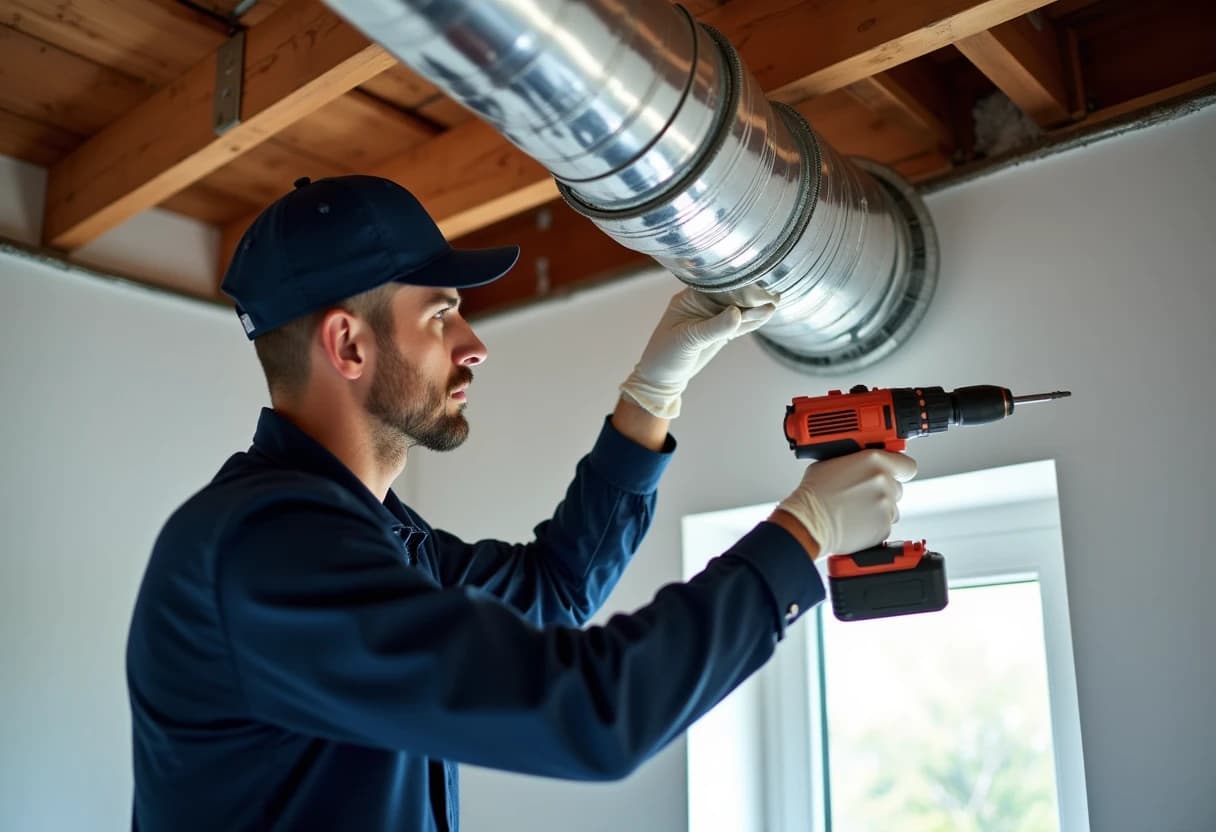
If your dryer's exhaust path includes plastic flex hose, a window insert, a bucket of water, or a mysterious duct that ends somewhere inside the house, you need an installation — and you are not alone: we find improvised venting in Hamilton homes every month. Indoor termination is the worst offender, pumping a gallon of moisture and a load of lint into living space or structure per cycle; long flex runs are a close second. We replace all of it with an engineered system: rigid metal duct on the shortest workable route, sealed and supported, terminating outdoors through a proper hood. The work typically takes half a day to a day, and we verify the result with the dryer running before we leave.
Why Dryer Vent Installation & Rerouting Matters for Hamilton Homes
Length is the invisible constraint most existing vents violate. A dryer is a modest blower pushing moist, fiber-laden air, and its reach is finite: the code's 35-foot equivalent-length budget shrinks fast when elbows are counted — a typical deduction of five feet per 90-degree bend and two and a half per 45 means a run with four corners has spent twenty feet of budget before its first straight section. Exceed the limit and physics takes over: airflow velocity drops below what carries lint, fibers settle in the duct, moisture condenses instead of exiting, and the system clogs on a schedule no cleaning interval can economically match. This is precisely the condition of countless Greater Boston vents, installed when the laundry moved but routed around, rather than through, whatever stood in the way. Rerouting solves it at the root. Our crews measure the true equivalent length, find the shortest legal path — often through a rim joist or closer wall the original installer ignored — and rebuild. Customers whose dryers limped for years routinely describe the result as getting a new appliance.
From the triple-deckers near Patton Park to the singles and capes out toward Bradley Palmer State Park, Hamilton presents every dryer venting challenge in the catalog: interior laundry rooms far from exterior walls, below-grade basements where the only exit is the rim joist, and condo layouts that force roof terminations. Hamilton is classic North Shore horse country: rambling antique farmhouses and estate homes on large acreage, mixed with modest mid-century capes and ranches in the South Hamilton village near the commuter rail. The estate properties often run multiple heating zones with long, complex duct networks, while the older farmhouses carry retrofit forced-air systems squeezed through 18th- and 19th-century framing. We have built vents through all of it. Between Appleton Farms, Myopia's fields and the town's working stables, Hamilton's air carries more hay dust, pollen and equestrian-related particulates than a typical suburb, and it shows in the return ducts we open here. Rural properties on well water and wooded lots also see heavier seasonal organic debris in their systems. Because our shop is about 32 miles away in West Newton, site visits and installs schedule quickly — and most Hamilton installations are complete, verified and cleaned up within a single day.
Our Dryer Vent Installation & Rerouting Process in Hamilton
1Site Assessment & Route Planning
The technician maps what exists and what is possible: where the dryer sits (or will sit), which walls are exterior, what the framing and foundation allow, and where obstacles — plumbing, wiring, ductwork, finished ceilings — constrain the path. Shortest is best: fewer feet and fewer elbows mean faster drying and slower lint accumulation for the life of the system.
2Demolition of Non-Compliant Venting
Where the old route will be reused, we strip it to sound structure; where it is abandoned, we seal the redundant penetrations properly — foam and blocking inside, patched and flashed outside — so the old path does not remain as an air leak or pest entry. Clean removal is part of the installation, not an extra.
3Cut & Flash the Exterior Penetration
The exterior opening is cut precisely for the termination: hole saw through clapboard and sheathing, core drill through brick, block or stone, or a framed opening at the rim joist. We locate it to respect required clearances from grade, openings and inside corners, then flash and seal it so wind-driven New England rain stays out of the wall assembly permanently.
4Install Rigid Metal Duct on the Planned Route
The run goes in as 4-inch smooth-interior rigid metal duct — the material the IRC specifies — cut to fit, joined male-to-female in the direction of airflow, and assembled without a single screw protruding into the airstream: joints are clamped or externally fastened and sealed with UL-listed foil tape. Elbows are used sparingly and counted against the length budget.
5Mount the Termination Hood & Damper
Where pests are a known pressure — and in Greater Boston they are — we fit guard designs engineered for dryer exhaust: excluding birds and rodents without restricting airflow or trapping lint. We also note the hood in your service record so future cleanings include damper checks, keeping the one wear-prone component watched for the system's life.
6Connect the Appliance & Seal the System
System sealing is completed end to end: every joint taped with UL-listed foil tape, the wall penetration sealed inside and out, and the transition clamped tight. A dryer vent is a pressure system; leaks anywhere cost airflow at the termination and push lint and moisture into places they do not belong. Sealed means sealed everywhere.
7Test, Verify & Document the Installation
You receive complete documentation: photos of the route (including concealed sections before they closed), the materials used, the equivalent-length math, and the finished termination. For permitted work, condo approvals or home sales, this record answers every question an inspector, board or buyer will ask about what is behind the walls.
Benefits of Professional Dryer Vent Installation & Rerouting in Hamilton
A Laundry Located Where You Actually Want It
Proper vent design frees the floor plan: a second-floor laundry, a kitchen-adjacent closet, a finished-basement corner all become viable when the exhaust route is engineered rather than improvised. We tell you honestly which locations work within the length budget — and often find compliant routes that make the layout you wanted possible.
Moisture Managed, Structure Protected
Moisture protection extends to the envelope itself: our flashed, sealed penetrations keep wind-driven rain out of walls and roofs for the long term. An installation is only as good as its weakest detail, and the exterior detail is the one that faces forty years of nor'easters. We build it like it will.
Dramatically Faster Drying
Every elbow removed and every foot shortened is resistance the dryer no longer fights on every load, forever. The performance gain is not subtle on bad systems — 30 to 50 percent cycle-time reductions are common when we replace overlong flex runs — and unlike an appliance upgrade, it benefits every dryer the laundry will ever have.
Permanently Lower Energy Costs
Sealed rigid duct also stops the hidden energy leaks of bad systems: conditioned air escaping through gapped joints, winter infiltration through failed dampers, and the heating-season cost of a laundry room with a permanent 4-inch draft. A tight system with a tight damper closes all of it.
Code Compliance That Closes Every Question
Insurers and condo associations increasingly ask about dryer venting after regional fire losses, and 'professionally installed to code, with photos' is the answer that ends the conversation. We provide certificates of insurance for association work and per-unit records for multi-family buildings as standard practice.
Decades of Service From a One-Day Job
Because we also clean and repair dryer vents across Greater Boston, we install with the next twenty years of maintenance in mind — routes our own brushes can traverse, access preserved where it matters, baselines recorded for future verification. We build systems we expect to service ourselves, and it shows in the choices.
Signs Your Hamilton Home Needs Dryer Vent Installation & Rerouting
The Run Is Overlong or Elbow-Heavy
Count the route: if your duct wanders more than roughly 25 linear feet, or turns more than three corners, it is likely past the code's 35-foot equivalent-length budget once elbows are deducted — typically five feet per 90-degree bend. Beyond the budget, the dryer physically cannot keep lint moving to the outlet, and chronic clogging is built in.
Your Vent Is Flexible Plastic or Foil Duct
Look behind and beyond your dryer: if the exhaust path is white vinyl or shiny foil accordion hose — especially if it disappears into a wall or ceiling that way — the system needs replacement, not another cleaning. Flex materials trap lint in every corrugation, crush at a touch, and in vinyl's case can melt. Codes and manufacturers rejected them long ago.
The Dryer Vents Indoors — Anywhere
Window inserts and condensation boxes marketed as 'indoor dryer vents' are not a solution for a standard vented dryer in a Massachusetts home; they are humidity machines. If one is in service in your laundry, a proper exterior route almost certainly exists — our assessment will find the shortest one and price it flat.
Blockages and Repairs Keep Recurring
Recurring appliance failures tell the same story from the other end: thermal fuses, heating elements and high-limit switches that fail repeatedly are a dryer protesting a duct it cannot push through. Each repair buys months. A rerouted, rigid, code-length run buys decades — and usually costs less than three appliance service calls.
A New Laundry Location Needs Its First Vent
Renovation is the moment of maximum leverage: we consult with homeowners and contractors while framing is open, position the laundry within the length budget, and rough in the run for pennies on the retrofit dollar. If your project touches the laundry's walls or ceiling, call before drywall — future you will be grateful.
Inspection, Insurance or Association Requirements
Massachusetts home inspections flag improvised dryer venting constantly — flex runs, screened hoods, indoor terminations, overlong routes — and the flag follows the transaction: buyers demand fixes, sellers concede credits. A documented compliant installation clears the item permanently, whether you are listing this spring or just retiring a known liability.
Dryer Vent Installation & Rerouting Cost in Hamilton, MA
Rerouting deserves its own cost frame, because its value is measured against the run it replaces. Shortening a 40-foot flex wander to a 12-foot rigid route typically costs $500 to $900 — and permanently removes the conditions that were costing you money continuously: second drying cycles (roughly $10 to $20 a month in energy for a busy household), twice-yearly cleanings instead of annual, recurring blockage calls, and the appliance repairs that backpressure schedules (thermal fuses and elements at $150 to $400 a visit). Most households with genuinely bad routes recover the rerouting cost within two to three years through those avoided expenses, then keep the savings for decades. There is also the risk column, harder to price but real: overlong flex runs are heavily represented in the roughly 2,900 annual US dryer fires, and their moisture leakage feeds mold remediation bills that start around $1,500. When we quote a reroute, we show you this math against your actual route — some marginal systems are worth keeping and maintaining, and we say so when they are.
Want the full pricing picture? See our complete Boston-area cost guide or call (617) 390-7145 for an exact flat quote for your Hamilton home.
Local Knowledge: Hamilton, Essex County
Every town's ductwork tells the story of its housing. Hamilton is classic North Shore horse country: rambling antique farmhouses and estate homes on large acreage, mixed with modest mid-century capes and ranches in the South Hamilton village near the commuter rail. The estate properties often run multiple heating zones with long, complex duct networks, while the older farmhouses carry retrofit forced-air systems squeezed through 18th- and 19th-century framing. Between Appleton Farms, Myopia's fields and the town's working stables, Hamilton's air carries more hay dust, pollen and equestrian-related particulates than a typical suburb, and it shows in the return ducts we open here. Rural properties on well water and wooded lots also see heavier seasonal organic debris in their systems. We plan Hamilton jobs around those realities, from equipment selection to time on site, and it shows in the results. If you live near Chebacco Lake or anywhere across Hamilton's 01982 area, we have almost certainly cleaned a system like yours before — and we can tell you exactly what to expect before we arrive.
The Best Time of Year in Hamilton
Humid summers argue for good vent design from the opposite direction. When dew points sit in the seventies, dryer exhaust barely cools before reaching saturation, and any route flaw — a belly, a leak, an oversized dead-air section — collects water through the muggy months while basement laundries add ambient humidity of their own. Summer is also when improvised indoor venting does its worst damage, loading attics and crawlspaces with moisture exactly when the structure cannot dry. And at the termination, summer is nesting season: hoods without proper dampers and guards acquire tenants between March and June. A properly designed system shrugs all of it off — sealed, sloped, insulated, guarded — which is why summer's symptoms are so often what finally send homeowners to the phone.
Why Choose Boston Air Duct Cleaners
Boston Air Duct Cleaners is a local, owner-operated company based at 1121 Washington St in West Newton — not a national franchise dispatching subcontractors. Every crew is our own: background-checked, factory-trained on commercial negative-pressure equipment, and fully insured. We quote flat prices before work begins, document every job with before-and-after photos, and follow NADCA-standard source-removal methods on every system we touch. That is why so much of our work comes from repeat customers, property managers and word-of-mouth referrals across Essex County.
Serving Hamilton and Surrounding Communities
Beyond Hamilton, our crews cover the surrounding communities daily — including Wenham, Ipswich, Essex, Topsfield, Manchester-by-the-Sea, Beverly. Because routes cluster geographically, booking alongside a neighboring appointment often unlocks same-day service and combined-visit savings. Wherever you are in Essex County, the same flat-rate pricing, insured technicians and photo-documented process applies.