
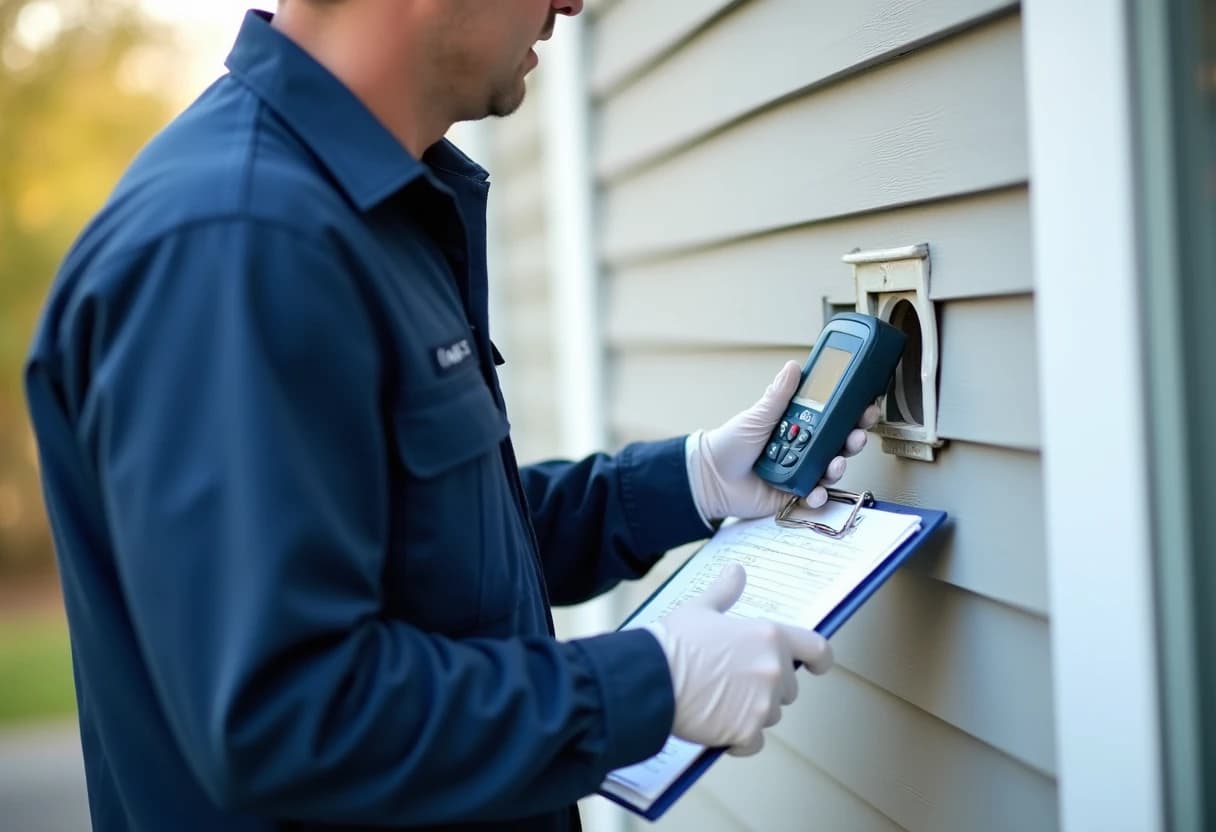
Not every dryer vent needs cleaning every year — but every dryer vent deserves inspecting every year, because the failure modes are silent and the worst-case outcome is a fire. Our Gloucester inspection service exists for homeowners who want the truth about their vent without committing to a service they may not need. We measure exhaust airflow, camera the complete duct run, check the termination hood, verify the installation against code, and score the lint load. Roughly a third of the vents we inspect are fine, and we say so in writing. The rest get a documented finding and a flat-rate path to fixing it — your call, no pressure.
Why Dryer Vent Inspection & Safety Check Matters for Gloucester Homes
The dryer vent is the only exhaust duct in your home that moves flammable material by design. Every load sheds lint; the trap catches most of it, and the rest travels the duct — where some fraction sticks at every elbow, joint, screw tip and rough surface along the way. Whether that accumulation is trivial or dangerous depends on the duct's length, geometry, material and history, which is exactly what an inspection evaluates. The residential code (IRC M1502) exists because these variables matter: it specifies smooth rigid metal duct, limits runs to 35 feet of equivalent length with deductions for every elbow, and prohibits screws that protrude into the airstream because each protruding tip becomes a lint anchor. Many Massachusetts homes — especially older ones retrofitted with laundry in basements or upper floors — violate one or more of these rules, often invisibly inside walls. A camera inspection is the only practical way to find out, and a written report is the only way to prove the vent's condition to an insurer, a buyer or a condo board.
Buying or selling in Gloucester? The dryer vent is the gap in almost every home inspection. America's oldest seaport is built largely of 19th-century fishermen's cottages, shingled capes and stately captains' houses, with village clusters in Annisquam and Lanesville that predate central heating entirely. Forced-air systems here are almost always retrofits threaded through old framing, and the salt-heavy marine air accelerates corrosion on duct seams, vent hoods and dryer exhaust terminations more than anywhere inland. General inspectors note the dryer's presence and move on; they do not camera the duct, measure the exhaust, or verify the hidden run complies with code — yet vent condition is a genuine safety and cost item, especially in older properties near Gloucester Fisherman's Memorial where laundry was retrofitted long after construction. On Cape Ann the ocean is the defining air-quality factor: persistent coastal humidity keeps duct interiors damp, and we routinely find rusted-through dryer vent hoods and mold-prone ductwork in homes just blocks from Gloucester Harbor. Exterior vent terminations near the water often need replacement years before their inland counterparts. We provide pre-listing and pre-purchase dryer vent inspections across Essex County with fast written reports that slot straight into a disclosure package or an inspection-response negotiation. Sellers use them to remove doubt; buyers use them to avoid inheriting someone else's fire risk.
Our Dryer Vent Inspection & Safety Check Process in Gloucester
1Interview & Visual Assessment
We start by listening: how long do loads take, has anything changed, when was the vent last cleaned, any moisture or odor issues? Then the technician examines the laundry area — dryer position, transition duct type and condition, visible connections — because the interview and the first look often predict exactly what the instruments will find.
2Airflow Measurement at the Termination
The single most telling test takes two minutes: dryer on, anemometer at the hood. Exhaust volume tells us how much of the dryer's rated airflow actually survives the trip through the duct. We record the reading in your report so future inspections can track the trend — a slow year-over-year decline is the earliest possible warning of developing blockage.
3Full-Length Camera Inspection
This is the step no flashlight can replace: a camera pass of the complete exhaust run, wall cavities and ceiling sections included. You can watch live as it travels. Lint depth, joint condition, duct material transitions and any obstructions are recorded, and representative frames go into your written report as evidence for every finding.
4Termination Hood & Damper Check
Outside, we evaluate the termination: does the damper open fully under dryer airflow and close cleanly at rest? Is the hood intact, sealed to the wall, and free of lint beards, paint-overs or screening that traps lint? A surprising share of vent failures live entirely at this last twelve inches of the system.
5Lint-Load Assessment & Fire-Risk Scoring
Combining the camera footage and airflow numbers, we score the system's lint load: how much fuel the duct is carrying and how fast it is accumulating based on household laundry volume. This converts raw findings into a clear risk statement — fine for now, clean this season, or clean immediately — with the evidence attached.
6Code-Compliance Review
We review the installation against the residential mechanical code for dryer exhaust: smooth rigid metal duct (not foil or plastic flex in concealed runs), a maximum of 35 feet equivalent length with deductions for each elbow, no screws penetrating the airstream, proper termination with a backdraft damper and no screen. Violations are photographed and explained.
7Written Safety Report & Recommendations
Everything we measured and saw goes into a written safety report delivered the same day. Pass or fail, you have proof of the vent's condition — the document buyers ask for, insurers accept and associations require. If work is warranted, the report doubles as a precise scope, so any quote you gather is comparing the same job.
Benefits of Professional Dryer Vent Inspection & Safety Check in Gloucester
Real-Estate & Insurance Documentation
Condo associations and landlords in Massachusetts are steadily adding dryer vent verification to their maintenance requirements after well-publicized multi-family lint fires. Our per-unit reports satisfy property managers and boards in one visit, with scheduling built for buildings — multiple units, one appointment block, individual documentation.
Fire Risk Caught Before It Matters
The roughly 2,900 dryer fires U.S. homes suffer each year share a common history: a restriction that built silently for years. Annual inspection breaks that pattern by catching declining airflow and accumulating lint at the measurement stage — years before the ignition stage. It is the cheapest intervention in fire prevention.
Hidden Code Violations Exposed
Code review matters most at transactions. A non-compliant vent discovered by a buyer's inspector becomes a negotiation weapon; the same finding surfaced by your own inspection becomes a controlled, competitively priced repair. Knowing first is worth far more than the inspection fee.
Lower Drying Costs & Longer Appliance Life
A restricted vent makes every load take longer, and longer cycles cost real money in electricity or gas — often hundreds of dollars a year in heavy-laundry households. Inspection catches restriction at the stage where a single cleaning restores one-cycle drying and normal operating costs.
A Written Report You Can Actually Use
Every inspection creates a baseline. Next year's airflow number is compared against this year's, which turns a single snapshot into a trend line — and trend lines catch developing problems that any single visit might reasonably pass. It is the difference between a photo and a medical history.
No Unnecessary Cleanings
Fear sells a lot of dryer vent cleanings that ducts did not need. Our answer is evidence: your own duct on camera, your own airflow in numbers. When the data says clean, we quote it flat; when it says pass, you keep your money and gain a report. Either way you decide from facts.
Signs Your Gloucester Home Needs Dryer Vent Inspection & Safety Check
The Dryer or Laundry Room Feels Hot
A dryer cabinet that is hot to the touch, or a laundry room that turns into a sauna mid-cycle, means exhaust heat is staying in the house instead of leaving through the duct. That trapped heat is the same heat that ignites lint. It warrants a measurement promptly.
You Cannot Remember the Last Service
If the vent has no service history you can name, assume it has never been inspected — most have not. NFPA guidance is simple: dryer exhaust should be checked at least annually. The first inspection establishes your baseline; every year after tracks the trend.
No Visible Exhaust at the Outside Hood
Step outside while the dryer runs: you should see the damper held open by strong airflow and feel a confident stream of warm air. A flap barely moving — or not moving at all — means severe restriction or a stuck damper, and the system needs professional attention.
Clothes Take More Than One Cycle
When towels come out damp after a full cycle, most people blame the dryer and call an appliance tech. In our experience the appliance is usually fine — the exhaust path is not. A twenty-minute airflow measurement settles the question before you pay for a repair visit the machine never needed.
Insurance, Condo or Sale Requirements
Multi-family buildings across Massachusetts are adding periodic dryer vent verification to bylaws after highly publicized lint fires in stacked-laundry buildings. If a notice has landed in your mailbox, we handle single units and whole buildings, with per-unit documentation the board can file.
Burning or Musty Smells During Operation
Musty smells on 'clean' laundry point to moisture lingering in the duct — often a low spot where condensation pools and lint mats into a damp plug. Beyond the odor, wet lint accumulations restrict flow badly and hide mold. The camera finds the low spot; the fix follows from there.
Dryer Vent Inspection & Safety Check Cost in Gloucester, MA
Three honest questions set your price. Where does the vent terminate — ground-level wall, second story, or roof? How long and complicated is the run — a straight 8-foot shot or 30 feet with four elbows through two floors? And is this a single home or a multi-unit building? Simple answers put you at $79; complex ones at $149; buildings get per-unit rates that drop with unit count. Two pricing notes worth knowing. First, our inspection fee is credited in full toward any cleaning we perform at the same visit, so the diagnostic never costs extra when work follows it. Second, beware of free inspections from cleaning companies — an inspection whose only revenue comes from selling you a cleaning is a sales call with a camera. Ours is priced as a standalone professional service precisely so the verdict can honestly be 'your vent is fine,' which it is roughly a third of the time.
Want the full pricing picture? See our complete Boston-area cost guide or call (617) 390-7145 for an exact flat quote for your Gloucester home.
Local Knowledge: Gloucester, Essex County
Serving Gloucester means knowing Gloucester. America's oldest seaport is built largely of 19th-century fishermen's cottages, shingled capes and stately captains' houses, with village clusters in Annisquam and Lanesville that predate central heating entirely. Forced-air systems here are almost always retrofits threaded through old framing, and the salt-heavy marine air accelerates corrosion on duct seams, vent hoods and dryer exhaust terminations more than anywhere inland. On Cape Ann the ocean is the defining air-quality factor: persistent coastal humidity keeps duct interiors damp, and we routinely find rusted-through dryer vent hoods and mold-prone ductwork in homes just blocks from Gloucester Harbor. Exterior vent terminations near the water often need replacement years before their inland counterparts. Those conditions shape how we work here: which brush heads come off the truck, how we protect finishes in older interiors, and what we expect to find when the camera goes into a 01930 duct system. Our crews are in and around Gloucester nearly every week — often for neighbors of past customers — so scheduling is fast and our arrival windows hold.
The Best Time of Year in Gloucester
Spring earns its own place on the inspection calendar because of what moves into vents between March and June: nesting birds. Starlings and house sparrows treat an uncapped or damaged dryer termination as prime real estate, and a nest turns a healthy vent into a near-total blockage within days. Our spring inspections put extra attention on the termination — damper integrity, hood condition, evidence of nesting activity — and catch bird problems before eggs complicate a humane removal. Spring is also when winter's damage surfaces: hoods cracked by ice, dampers stiffened by corrosion, joints loosened by months of freeze-thaw movement in the structure.
Why Choose Boston Air Duct Cleaners
Choosing a duct cleaner is really a trust decision — you are letting a crew work inside the system that feeds air to your family. We make that decision easy: a local West Newton company with insured, uniformed technicians, transparent flat-rate quotes, NADCA-standard equipment and methods, and photographic proof of the finished work. No door-to-door sales, no bait-and-switch coupons, no invented 'mold emergencies.' Just honest mechanical cleaning done properly the first time, backed by a written guarantee.
Serving Gloucester and Surrounding Communities
We serve every community around Gloucester as well: Essex, Manchester-by-the-Sea, Ipswich, Beverly, Hamilton, Wenham all fall inside our regular service routes. If you have a second property, a rental, or family nearby, ask about multi-home scheduling — grouped appointments on the same route are our most requested discount.