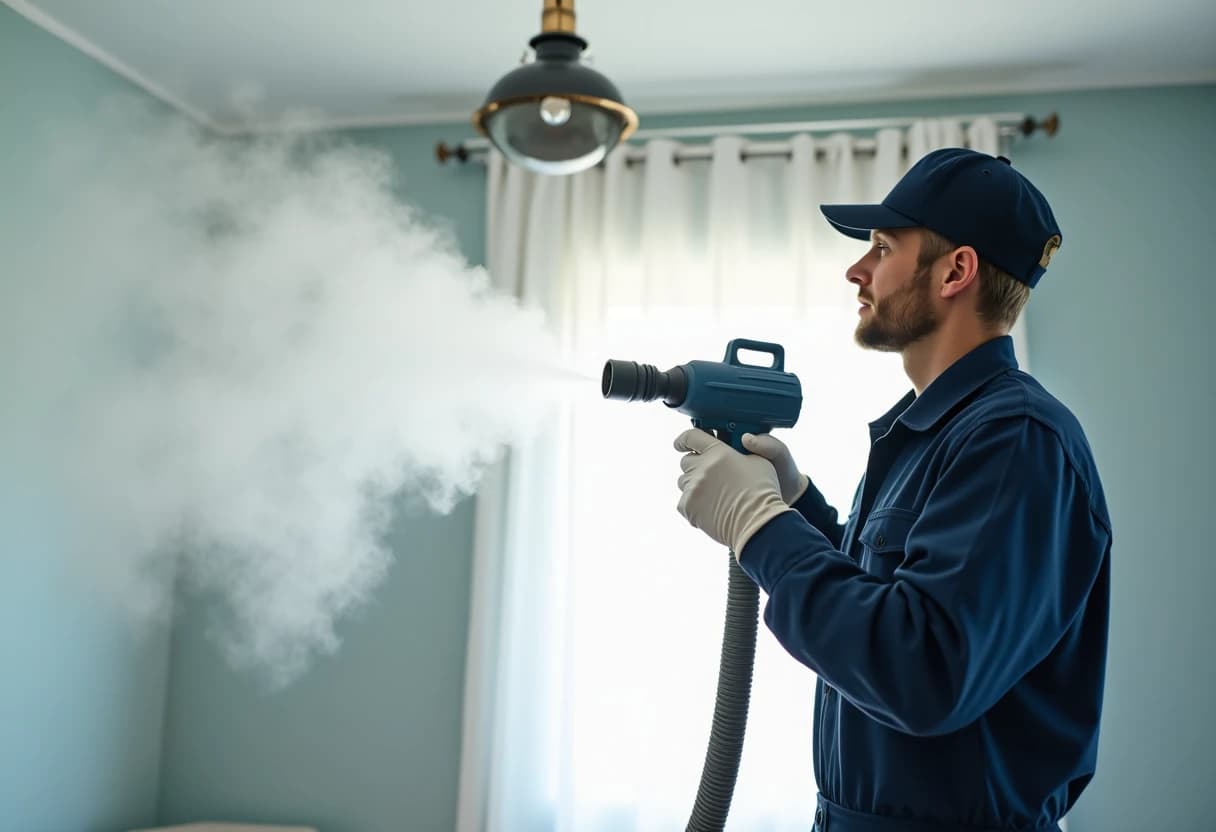
Buying a home means inheriting its air system exactly as the previous owners left it — their pets, their cooking, their smoking habits, their damp basement, all archived in the duct film and re-broadcast every time the heat or AC runs. Duct sanitizing is the move-in reset Carlisle buyers ask us for most: a full source-removal cleaning followed by EPA-registered antimicrobial fogging that neutralizes the biological residue cleaning alone leaves behind. It is equally popular after pest issues, mold findings, water events and smoke exposure — any situation where you want the air path not just cleaned but decontaminated. One visit, and the house stops smelling like somebody else's.
Why Air Duct Sanitizing & Deodorizing Matters for Carlisle Homes
Certain situations turn sanitizing from optional to strongly advised. After confirmed microbial growth or a mold finding, treatment of the cleaned surfaces inhibits recolonization while the moisture fix takes hold. After rodent or pest activity in the ductwork, sanitizing addresses the bacterial and viral load droppings leave behind — a genuine health matter, not merely an aesthetic one. After fire or heavy smoke exposure, deodorizing treatment neutralizes the acrid residue that otherwise off-gasses for years. After a water event, it suppresses the microbial bloom that damp ducts incubate. And at move-in, it resets a system whose history you cannot verify. In each case the logic is the same: cleaning removes what is visible, sanitizing addresses what is biological. Conversely — and we say this plainly because the industry often will not — a routinely maintained system with no odor, no moisture history and no contamination event does not need sanitizing, and the EPA does not recommend routine biocide use in ducts. We inspect first and recommend accordingly. Roughly a third of the time, our recommendation is to skip it.
Duct odors in Carlisle have local fingerprints. Carlisle's two-acre zoning produced a landscape of large custom colonials and contemporaries from the 1970s onward, scattered among 18th- and 19th-century farmhouses along the old town roads. These big rural homes typically run multi-zone forced-air systems with hundreds of feet of ductwork, and nearly all are on well and septic with full basements. Systems in these homes have been absorbing household life for decades — pets, kitchens, tobacco, damp cellars — and the interior film holds all of it. Carlisle's heavily wooded lots mean spring pollen and fall leaf mold pour into outdoor units and returns, and the town's oversized multi-zone systems hide far more duct surface than owners expect. Farm fields and the cranberry bog add seasonal dust that shows up in return grilles across town. When our crews sanitize Carlisle systems, the before-and-after is often startling to owners who had gone nose-blind: the EPA-registered fogging lands on freshly cleaned metal, the biological residue neutralizes, and the house exhales decades of accumulated character in a single afternoon.
Our Air Duct Sanitizing & Deodorizing Process in Carlisle
1Odor Assessment & Honest Qualification
We qualify the job before we book the fog. Odors that ride the airflow, spike at cycle start, or track the seasons implicate the system; odors independent of airflow usually do not. The assessment separates the two, checks for the moisture or contamination that sometimes underlies duct smells, and produces a flat written quote for exactly the work your situation supports.
2Source-Removal Cleaning First
Step one is removing the reservoir. The odor-saturated film lining your ducts is physically extracted under negative pressure — rotary brushes and pneumatic whips strip it from every supply, return and trunk while the HEPA vacuum captures it. Most of the odor leaves the house in this step; the fogging that follows neutralizes what remains and prevents the smell from rebuilding.
3Product Selection & Preparation
We match the chemistry to the problem: an EPA-registered antimicrobial labeled for HVAC use as the base treatment, with odor-counteractant chemistry added for smoke, pet or severe musty situations. You see the product names and safety data sheets before application — never a vague 'proprietary treatment' — and we review re-entry timing, typically just a few hours, with you up front.
4Whole-System Antimicrobial Fogging
Fogging is the delivery method that makes duct sanitizing whole-system rather than spot treatment. Atomized at the micron scale, the antimicrobial behaves like the air itself, riding the airflow into every branch, riser and return the blower serves. Everywhere your air travels, the treatment travels — which is precisely why it works on odors that a hand-sprayed register never touches.
5Coil, Drain Pan & Blower Treatment
Your system's odor epicenter is usually the equipment, not the ducts: the coil and drain pan stay wet all cooling season, breeding the bacteria behind classic dirty-sock smell. We clean and treat both, clear the condensate trap, and sanitize the blower assembly that pushes air past them — closing the loop so the freshly treated ductwork is not immediately re-contaminated from upstream.
6Deodorizing Pass for Stubborn Odors
Antimicrobial treatment handles biological odors, but some smells are chemical: tar and nicotine films, cooking-oil residue, fire smoke. For those, we deploy counteractants that chemically neutralize the odor compounds themselves. The distinction matters — treating a smoke house with antimicrobial alone leaves the tar film broadcasting — and diagnosing which chemistry your odor needs is exactly what the initial assessment is for.
7System Airing, Verification & Walkthrough
The finish is verification by nose and by paper: a room-by-room airflow check confirming neutral odor at every register, before-and-after photos of the duct interiors, and a written record of products applied with their EPA registration numbers. Surfaces are dry and the home fully usable by the time we pack up in nearly all cases — we review any exceptions before we start, never after.
Benefits of Professional Air Duct Sanitizing & Deodorizing in Carlisle
A True Reset for Newly Purchased Homes
The previous owners' pets, kitchen, tobacco and habits are archived in your duct film, replaying on every cycle. Cleaning plus sanitizing erases the archive — mechanically stripping the residue, then neutralizing the biology — so the house starts smelling like yours from day one. It is the single most-requested reason for this service, and the reviews it generates say 'finally smells like our home.'
Odors Neutralized at the Source, Not Masked
Every consumer odor product adds scent on top of the problem; sanitizing subtracts the problem. With the odor-holding film removed and the residue chemically neutralized, the ducts stop producing smell altogether. The house does not smell like a candle aisle afterward — it smells like nothing, which is what fresh actually is, and what no masking product can counterfeit.
Pet Odor Elimination That Actually Holds
Multi-pet and long-tenure pet households benefit most: the accumulation scales with animal-years, and no surface cleaning touches the duct-borne share. Post-treatment, the improvement compounds — ongoing dander still sheds, but it lands in a neutral system rather than layering onto decades of saturated film, and routine filter changes keep the new baseline for years.
Microbial Load Reduced System-Wide
Ducts are a microbial habitat by design — dark, textured, dust-fed and periodically damp. Sanitizing knocks the resident population down to baseline and leaves an inhibiting residue that slows recolonization for years. It is not sterility, and no honest company promises that; it is a substantially cleaner biological starting point for all the air you breathe at home.
Musty Summer Smell Broken for Good
That damp blast at AC start-up is bacteria metabolizing humid duct film — a cycle that returns every muggy stretch and worsens annually. Sanitizing removes the film and leaves treated surfaces the biology cannot recolonize, so the next humid week produces silence from the registers. For many Massachusetts households this is the first summer without the smell in a decade.
Smoke Ghosts Finally Evicted
Tobacco residue is the most persistent household odor there is — tar and nicotine films bond to duct metal and off-gas for years, outliving paint, carpet and every previous owner. Our layered treatment pairs antimicrobial fogging with odor-counteractant chemistry that neutralizes the smoke compounds specifically, which is why it succeeds where repainting and time both failed.
Signs Your Carlisle Home Needs Air Duct Sanitizing & Deodorizing
Pets Present or Past
The threshold question: can guests tell you have animals without seeing them? If yes, the ducts are broadcasting, and the smell is stronger than your adapted nose reports. Households with multiple pets or long pet tenure carry proportionally heavier duct reservoirs, and they see the most dramatic before-and-after from a single cleaning-plus-treatment visit.
Smoke History in the Home
After a kitchen fire, wildfire smoke event or nearby structure fire, ducts inhale smoke even when flames never touched the house, and the system re-releases the odor long after surfaces are cleaned. Restoration protocols increasingly include duct treatment as standard; if yours did not, the lingering smell is telling you what was skipped.
Guests Notice a Smell You No Longer Can
Nose-blindness is real and universal: constant exposure deletes a smell from your perception while every visitor gets it full strength at the door. If a candid friend, a relative or a real estate agent has mentioned a pet, smoke or musty note you cannot detect, believe them — and suspect the ducts, because whole-house odors are almost always airflow-distributed.
Musty Blast When the Heat or AC Starts
Many households normalize this smell for years — a funky thirty seconds, then fine, so it never quite becomes a project. It should: the odor is live biology metabolizing residue in your air path, it recurs because the substrate remains, and it trends worse. One treatment visit ends a nuisance you had stopped noticing you tolerated.
After Pests, Mold or Water in the System
Rodent or insect activity in ductwork leaves droppings, nesting debris and bacterial contamination that mechanical cleaning removes but does not neutralize — the sanitizing pass is what addresses the biological load. Any pest history that touched the air system should end with an EPA-registered treatment, and the odor benefit arrives as a bonus.
You Just Bought the Home
An unknown air system is a reasonable default for sanitizing: you cannot see the duct film's history, and whatever the previous owners' household deposited — pets, smoke, cooking, dampness — is now on replay in your air. Between closing and move-in is the ideal window: empty rooms, open access, and a fresh biological baseline before your family breathes the system daily.
Air Duct Sanitizing & Deodorizing Cost in Carlisle, MA
Three questions set your price. First, is the system clean? Freshly cleaned ducts qualify for standalone treatment pricing; ducts carrying normal accumulation need the cleaning-plus-sanitizing bundle, because fogging over dust fails chemically. Second, what is the odor? Musty, pet and general staleness respond to the EPA-registered antimicrobial pass; tobacco, fire smoke and heavy cooking residue need the additional counteractant chemistry, which adds modestly to the price. Third, how big is the system? A compact ranch with ten runs sits at the range's bottom; a three-zone colonial with twenty-five runs sits at the top, purely on product volume and application time. Across Middlesex County, typical outcomes: $325 to $550 bundled for average homes, $500 to $700 bundled for large ones, standalone treatments from $250. Every quote includes the wet-section work — coil, pan, blower — because skipping the system's dampest components to hit a teaser price defeats the treatment, and we would rather explain the honest number than discount our way to a callback.
Want the full pricing picture? See our complete Boston-area cost guide or call (617) 390-7145 for an exact flat quote for your Carlisle home.
Local Knowledge: Carlisle, Middlesex County
Every town's ductwork tells the story of its housing. Carlisle's two-acre zoning produced a landscape of large custom colonials and contemporaries from the 1970s onward, scattered among 18th- and 19th-century farmhouses along the old town roads. These big rural homes typically run multi-zone forced-air systems with hundreds of feet of ductwork, and nearly all are on well and septic with full basements. Carlisle's heavily wooded lots mean spring pollen and fall leaf mold pour into outdoor units and returns, and the town's oversized multi-zone systems hide far more duct surface than owners expect. Farm fields and the cranberry bog add seasonal dust that shows up in return grilles across town. We plan Carlisle jobs around those realities, from equipment selection to time on site, and it shows in the results. If you live near Towle Field or anywhere across Carlisle's 01741 area, we have almost certainly cleaned a system like yours before — and we can tell you exactly what to expect before we arrive.
The Best Time of Year in Carlisle
Summer humidity is the engine of Greater Boston's duct-odor cycle. When dew points camp in the high 60s, moisture condenses on every cool surface in the air path — coil, pan, basement trunk lines — and the organic film absorbs it like a sponge. Bacteria respond within days, and their metabolism is the musty smell that arrives with every cooling cycle from July onward. Coastal and near-coastal homes get an extended version, with marine air keeping duct-adjacent spaces damp well into fall. Sanitizing breaks the biological half of the cycle; pairing it with the moisture-side fixes — insulating sweating runs, managing basement humidity, keeping condensate lines clear — breaks the whole loop, and the pairing is what turns a yearly complaint into a solved problem.
Why Choose Boston Air Duct Cleaners
As a West Newton-based company, we treat Carlisle like the neighborhood it is — because for us, it is. Our reputation lives or dies on local referrals, so every job gets the full process: complete system cleaning under negative pressure, mechanical agitation of every run, blower compartment service, and a documented walkthrough before we leave. We are licensed and insured, our estimates are free and flat, and our schedule holds same-day slots for urgent calls. One visit and you will understand why neighbors keep our magnet on the fridge.
Serving Carlisle and Surrounding Communities
Carlisle sits in the heart of our service area, and neighboring Concord, Acton, Bedford, Chelmsford, Billerica appointments share the same routes. That density is why our response times in this part of Middlesex County are among our fastest — and why you will see our trucks in the area week after week.