
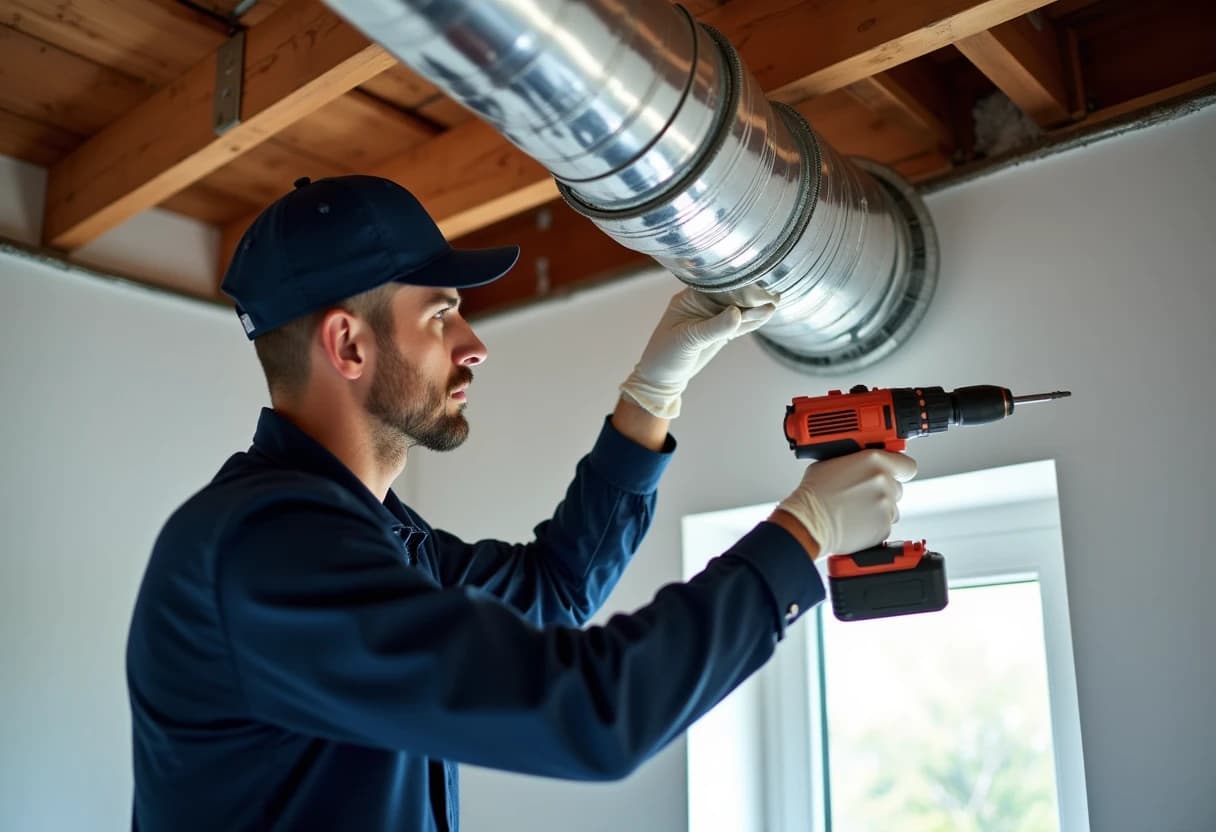
Some dryer vents cannot be cleaned or repaired into safety — they were never right to begin with. Runs assembled from vinyl or foil flex duct, routes that wander fifty feet through a basement, dryers venting into crawlspaces or garages, laundry areas with no vent at all: these call for installation, not maintenance. Our Brighton crews design and build code-compliant dryer exhaust systems from scratch — 4-inch smooth rigid metal duct, the shortest practical route to outdoors, joints without airstream-piercing screws, and a proper damper-equipped termination through the side wall, roof or rim joist. Priced flat from $300 to $900, finished in a day, and built to outlast the dryer itself.
Why Dryer Vent Installation & Rerouting Matters for Brighton Homes
There is also a straightforward performance and cost case. A dryer on a proper vent dries a standard load in one cycle; on a bad vent, in two — doubling energy per load, roughly $10 to $20 a month for a busy household, while heat-cycling the machine toward early component failure. A rigid, correctly sloped, correctly sized system also changes the maintenance economics: annual cleanings on smooth duct are quick and thorough, blockage-level service calls largely disappear, and appliance repairs caused by backpressure — thermal fuses, elements, high-limit switches — stop recurring. Add the avoided moisture damage (each load carries about a gallon of water that either exits the termination or enters your building assemblies) and the installation typically pays a real fraction of its cost back within a couple of years, then keeps paying. For homes about to sell, documented code-compliant venting removes a standard inspection flag before it costs a negotiation. For homes about to install a new dryer, it protects the warranty, which manufacturers condition on adequate exhaust. Either way, it is infrastructure bought once and used every laundry day for decades.
A large share of our Brighton installation work is corrective: replacing what a previous decade improvised. Brighton mixes early-1900s triple-deckers and two-families around Brighton Center and Oak Square with substantial brick apartment blocks along Commonwealth Avenue and a wave of new mid-rise condo construction near Boston Landing. Older multifamilies commonly run separate gas furnaces per unit with short, cramped basement duct trunks, while the new buildings rely on rooftop units and vertical riser ducts that need periodic professional attention. Condo conversions of the old stock frequently leave construction dust sitting in the ductwork. Behind those walls we find vinyl hose stapled to joists, flex duct wandering forty feet to a screened hood, vents dumping into crawlspaces — installations that fail the IRC's dryer exhaust rules on every line. Brighton borders our home city of Newton - Oak Square is barely ten minutes from our West Newton shop - so we're in the neighborhood constantly. The building boom around Boston Landing and New Balance's campus has kept construction dust in the air for a decade, and we regularly find drywall powder and sawdust inside duct systems of both brand-new units and the older homes downwind of the work. We tear out the improvisation and build the system the code describes: 4-inch rigid metal on the shortest workable route, clamped and taped joints, a damper-equipped termination sealed to the envelope. Documented with photos, verified with the dryer running.
Our Dryer Vent Installation & Rerouting Process in Brighton
1Site Assessment & Route Planning
Every installation begins with the route. We assess the laundry location, measure candidate paths to the exterior, and score each against the code's 35-foot equivalent-length budget — deducting for every elbow — and against your home's structure: framing, foundation type, finished spaces, and where a termination can legally and sensibly exit. You get options with trade-offs explained, and a flat price for the route you choose.
2Demolition of Non-Compliant Venting
Old venting comes out carefully, not destructively: we protect finishes, keep openings minimal, and document conditions as we find them. What we uncover often explains years of symptoms — a crushed flex section behind a wall, a joint that separated a decade ago, a cavity lined with escaped lint. Photos go in your record.
3Cut & Flash the Exterior Penetration
Roof terminations get roofing-grade treatment: shingles lifted and re-laid over proper flashing, a cap rated for dryer exhaust with a working damper, and sealant appropriate to the roofing material. We schedule roof penetrations for dry weather and verify water-tightness before leaving — a roof leak is not an acceptable side effect of a laundry upgrade.
4Install Rigid Metal Duct on the Planned Route
Where the route crosses unheated space — a cold basement, garage bay, attic run — we insulate the duct so exhaust stays above its dew point until it exits, which is the difference between a dry duct and a condensation problem in a Massachusetts winter. Concealed sections are completed and verified before any finishes close them in.
5Mount the Termination Hood & Damper
Where pests are a known pressure — and in Greater Boston they are — we fit guard designs engineered for dryer exhaust: excluding birds and rodents without restricting airflow or trapping lint. We also note the hood in your service record so future cleanings include damper checks, keeping the one wear-prone component watched for the system's life.
6Connect the Appliance & Seal the System
System sealing is completed end to end: every joint taped with UL-listed foil tape, the wall penetration sealed inside and out, and the transition clamped tight. A dryer vent is a pressure system; leaks anywhere cost airflow at the termination and push lint and moisture into places they do not belong. Sealed means sealed everywhere.
7Test, Verify & Document the Installation
You receive complete documentation: photos of the route (including concealed sections before they closed), the materials used, the equivalent-length math, and the finished termination. For permitted work, condo approvals or home sales, this record answers every question an inspector, board or buyer will ask about what is behind the walls.
Benefits of Professional Dryer Vent Installation & Rerouting in Brighton
Permanently Lower Energy Costs
A dryer that finishes in one cycle instead of two uses half the energy per load — a difference worth $10 to $20 a month to a busy household, recurring for the life of the system. Few building improvements have a payback mechanism this direct: the installation cost is fixed once, and the savings arrive with every laundry day after.
Decades of Service From a One-Day Job
Rigid metal duct, properly supported and sealed, is lifetime infrastructure: it does not kink, sag, melt or degrade, and it routinely outlasts several dryers. After installation day, the system's entire maintenance schedule is an annual cleaning and an occasional glance at the damper. Most homeowners never think about it again — which is the point.
Code Compliance That Closes Every Question
Insurers and condo associations increasingly ask about dryer venting after regional fire losses, and 'professionally installed to code, with photos' is the answer that ends the conversation. We provide certificates of insurance for association work and per-unit records for multi-family buildings as standard practice.
Moisture Managed, Structure Protected
For basement laundries — the Massachusetts default — proper installation is the difference between a dry basement and a damp one. Vents that dump into crawlspaces, leak at joints or condense in cold runs feed exactly the humidity and mold problems New England basements already fight; a correct rim-joist installation removes the dryer from that fight entirely.
Fire-Safe by Design, Not by Vigilance
The safety margin compounds with maintenance: rigid duct is fully brushable, so every annual cleaning actually reaches every surface — something no cleaning can honestly claim on a corrugated flex run threaded through cavities. You are not just starting cleaner; you are cleanable, permanently.
A Laundry Located Where You Actually Want It
Proper vent design frees the floor plan: a second-floor laundry, a kitchen-adjacent closet, a finished-basement corner all become viable when the exhaust route is engineered rather than improvised. We tell you honestly which locations work within the length budget — and often find compliant routes that make the layout you wanted possible.
Signs Your Brighton Home Needs Dryer Vent Installation & Rerouting
A New Laundry Location Needs Its First Vent
Renovation is the moment of maximum leverage: we consult with homeowners and contractors while framing is open, position the laundry within the length budget, and rough in the run for pennies on the retrofit dollar. If your project touches the laundry's walls or ceiling, call before drywall — future you will be grateful.
The Dryer Vents Indoors — Anywhere
Window inserts and condensation boxes marketed as 'indoor dryer vents' are not a solution for a standard vented dryer in a Massachusetts home; they are humidity machines. If one is in service in your laundry, a proper exterior route almost certainly exists — our assessment will find the shortest one and price it flat.
Inspection, Insurance or Association Requirements
Appliance warranties add quiet pressure: manufacturers condition coverage on adequate exhaust, and a warranty claim on a dryer connected to a non-compliant vent can be denied on that basis. If you are buying a premium machine, the few hundred dollars of proper venting is also warranty insurance.
Your Vent Is Flexible Plastic or Foil Duct
Flex duct concealed in walls and cavities is the worst case: it cannot be effectively brushed, so no cleaning ever truly clears it, and it accumulates lint until it blocks. If a cleaning service has ever told you your run 'can't really be cleaned,' this is what they meant — and rigid replacement is the answer.
Blockages and Repairs Keep Recurring
If your vent needs cleaning twice a year, blocks anyway, and has accumulated a history of repairs, the route itself is the problem — too long, too bent, wrong materials, or condensation-prone by design. At some point serial maintenance costs more than the reroute that ends it. We will do that math with you honestly; often the crossover is closer than expected.
The Run Is Overlong or Elbow-Heavy
Basement laundries venting to a far wall are the classic offenders — installed where the first hole was easiest, not where the route was shortest. Our assessment often finds a rim-joist or near-wall exit that cuts the run by half or more. Ask for the measurement; the equivalent-length math takes ten minutes and settles the question.
Dryer Vent Installation & Rerouting Cost in Brighton, MA
Multi-family and condo installation pricing carries a few specifics worth knowing up front. Roof terminations — common for interior condo laundries — sit toward the top of the range for the flashing and access work, typically $650 to $900 for the full installation. Association requirements add process rather than much cost: we provide written scopes for board approval and certificates of insurance at no charge, and our documentation is built to satisfy trustee and management-company review. The meaningful savings lever is coordination: when a triple-decker owner or association books multiple units in one mobilization, shared setup, staging and travel drop per-unit pricing by 20 to 30 percent, and the building ends up with one consistent, compliant system instead of three eras of improvisation. For laundry-relocation projects inside renovations, timing is the lever: venting roughed in while walls are open routinely costs $200 to $400 less than the identical route built after finishes, which is why we encourage a planning call at the framing stage — free advice that saves real money.
Want the full pricing picture? See our complete Boston-area cost guide or call (617) 390-7145 for an exact flat quote for your Brighton home.
Local Knowledge: Brighton, Suffolk County
Serving Brighton means knowing Brighton. Brighton mixes early-1900s triple-deckers and two-families around Brighton Center and Oak Square with substantial brick apartment blocks along Commonwealth Avenue and a wave of new mid-rise condo construction near Boston Landing. Older multifamilies commonly run separate gas furnaces per unit with short, cramped basement duct trunks, while the new buildings rely on rooftop units and vertical riser ducts that need periodic professional attention. Condo conversions of the old stock frequently leave construction dust sitting in the ductwork. Brighton borders our home city of Newton - Oak Square is barely ten minutes from our West Newton shop - so we're in the neighborhood constantly. The building boom around Boston Landing and New Balance's campus has kept construction dust in the air for a decade, and we regularly find drywall powder and sawdust inside duct systems of both brand-new units and the older homes downwind of the work. Those conditions shape how we work here: which brush heads come off the truck, how we protect finishes in older interiors, and what we expect to find when the camera goes into a 02135 duct system. Our crews are in and around Brighton nearly every week — often for neighbors of past customers — so scheduling is fast and our arrival windows hold.
The Best Time of Year in Brighton
Renovation season drives our installation rhythm as much as weather does. Greater Boston remodels from spring through fall — basements finished, laundries moved upstairs, triple-deckers converted to condos — and every one of those projects needs dryer exhaust designed rather than improvised. The economics of timing are stark: venting planned at framing stage routes shorter, conceals cleaner and costs $200 to $400 less than the same run retrofitted after drywall. We take planning calls from homeowners and contractors all season, often walking a route in fifteen minutes that saves the project real money and the homeowner a decade of compromise. If your project touches the laundry — or could move it somewhere better — the cheapest vent you will ever build is the one designed before the walls close.
Why Choose Boston Air Duct Cleaners
Choosing a duct cleaner is really a trust decision — you are letting a crew work inside the system that feeds air to your family. We make that decision easy: a local West Newton company with insured, uniformed technicians, transparent flat-rate quotes, NADCA-standard equipment and methods, and photographic proof of the finished work. No door-to-door sales, no bait-and-switch coupons, no invented 'mold emergencies.' Just honest mechanical cleaning done properly the first time, backed by a written guarantee.
Serving Brighton and Surrounding Communities
We serve every community around Brighton as well: Allston, Newton, Brookline, Watertown, Cambridge, Boston all fall inside our regular service routes. If you have a second property, a rental, or family nearby, ask about multi-home scheduling — grouped appointments on the same route are our most requested discount.