
Every dryer in your building is a small fire waiting on maintenance. FEMA attributes roughly 2,900 clothes dryer fires a year in US homes to exactly the failure this service prevents — lint accumulation in vents and ducts, the leading ignition factor. For condo associations, HOAs, apartment owners and property managers in Billerica, that risk multiplies by the unit count: dozens of dryers, dozens of vent runs, and in many buildings shared risers where one resident's lint becomes everyone's hazard. Our multi-unit dryer vent cleaning program handles the whole building in one coordinated visit — every unit's vent mechanically cleaned end to end, airflow verified, exceptions documented — and closes with a per-unit compliance report your board, manager and insurance carrier can file.
Why Commercial & Multi-Unit Dryer Vent Cleaning Matters for Billerica Homes
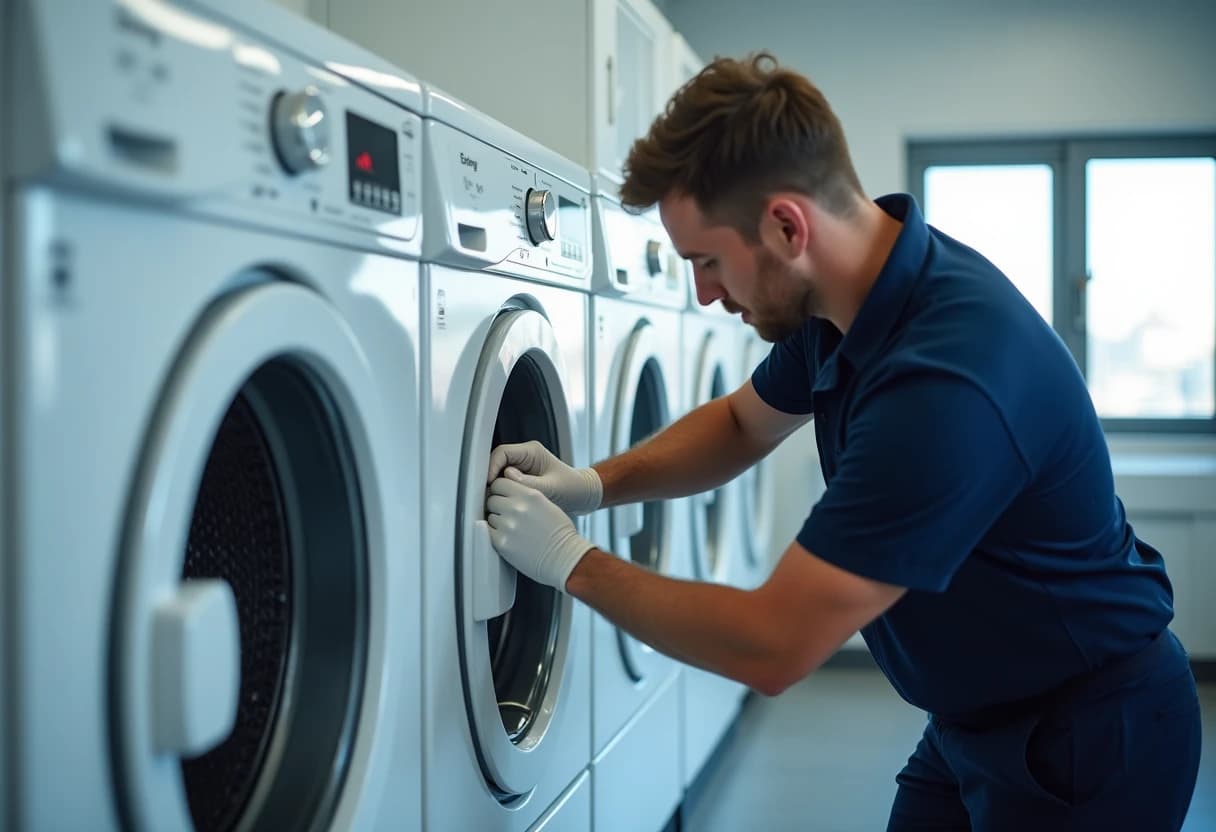
Laundromats and high-duty commercial laundry face the same physics at industrial intensity. A commercial dryer cycling ten hours a day produces more lint in a week than a household machine does in a year, and that lint loads into manifolded duct systems that were often sized optimistically to begin with. The operational symptoms arrive before the fire risk peaks: dry times stretch, customers complain and leave, gas consumption climbs, high-limit switches trip, and machines cook their own components in the trapped heat. NFPA 211 and equipment manufacturers alike call for regular exhaust cleaning at commercial duty cycles — quarterly or better in busy stores, not the annual rhythm of a home. Our commercial program matches the interval to your throughput: full mechanical cleaning of each machine's run and every common trunk, termination and damper service, booster fan cleaning where installed, and airflow verification numbers before and after so you can see the recovery. Most operators find the service pays for itself in gas savings and machine uptime before the fire-safety benefit is even counted.
Multi-unit housing defines Billerica, and its dryer venting shows the accumulated improvisation of decades. Billerica boomed as a blue-collar suburb in the 1950s through 70s, leaving it thick with capes, ranches and split-entries, many of them expanded with family-room additions and finished basements over the decades. Original ductwork in these homes is often undersized panned-joist returns - literally the floor framing used as duct - which collects decades of debris and is a top reason Billerica systems test dirty. In buildings like these, vents were often added long after construction — routed through basements, snaked to whatever wall was nearest, extended during renovations — and many have never been professionally cleaned since installation. Billerica's panned-joist return systems are a specialty of ours: those open framing cavities pull in insulation fibers, pet dander and basement dust for fifty years before anyone looks inside. Around Nutting Lake, seasonal homes converted to year-round use add damp crawlspace runs to the mix, so we bring moisture meters as standard practice. Our crews work Billerica buildings regularly and carry what its stock demands: rotary systems for long improvised runs, ladder and roof access for upper-floor terminations, and the patience for buildings where every unit's vent tells a different story. Boards get one proposal, one project, one per-unit report.
Our Commercial & Multi-Unit Dryer Vent Cleaning Process in Billerica
1Building Walkthrough & Per-Unit Proposal
First we learn your building's venting anatomy, because no two multi-unit buildings vent alike. Stacked risers, basement manifolds, improvised renovation-era runs and individual wall vents each demand different equipment and time. The walkthrough maps it, a camera check of representative runs establishes condition honestly, and your written proposal reflects the actual building — not a per-vent teaser that grows on site.
2Resident Coordination & Scheduling
Access is the hard part of multi-unit work, and we manage it for you. Our coordinator provides notice templates for management to distribute, builds a unit-by-unit schedule in efficient sequences, confirms time windows, and tracks completions and no-access units in real time. Buildings typically complete in one to three days, and residents are in their homes for minutes, not hours.
3Dryer-Side Service: Transition Duct & Connection
In each unit we pull the dryer, clean behind and beneath it — a major hidden lint reservoir — and service the transition duct between machine and wall. Foil accordion transitions, which manufacturers prohibit and which trap lint in every corrugation, are flagged and can be replaced on the spot with code-appropriate material. The connection is reseated and secured without airstream-penetrating screws, per code.
4Mechanical Cleaning of the Full Vent Run
Compressed-air whips and rotary brushes work the duct from the unit connection toward the termination, mechanically stripping the lint mat that blowers and leaf-blower shortcuts merely compact. Every elbow — each one worth 5 feet of equivalent length under code math, and each one a lint trap in practice — gets deliberate attention. Extracted lint is bagged per unit, which residents find quietly persuasive.
5Shared Risers, Common Trunks & Booster Fans
Stacked buildings route multiple dryers into shared vertical risers, and these common elements are where multi-unit lint risk concentrates — no resident can clean them, and every household loads them. We service risers from terminations and access points with vertical-run equipment, clean common horizontal trunks and basement manifolds, and service inline booster fans, whose blades cake with lint and quietly fail.
6Termination Service & Exterior Verification
We finish each run where the air does: at the outside wall or roof. The termination is cleaned, its flap or damper exercised and verified, screens and nests removed, and the exhaust confirmed to discharge outdoors — not into an attic, soffit or crawlspace, a dangerous and surprisingly common Massachusetts finding. Interior-terminating vents are documented as the priority hazards they are.
7Airflow Verification & Building Compliance Report
Verification is what separates a maintenance program from a receipt. We confirm restored airflow run by run, re-photograph representative ducts against their before images, and compile the compliance report: every unit's status, every exception explained, every hazard located and pictured, every recommendation priced separately for board action. Associations on our annual program receive the same format each cycle, so year-over-year condition is genuinely comparable.
Benefits of Professional Commercial & Multi-Unit Dryer Vent Cleaning in Billerica
Directly Reduced Fire Risk, Building-Wide
The comparison that matters is cost per risk retired. For a modest per-door price, an association eliminates its most preventable fire hazard for the year — one whose national loss statistics, per NFPA and FEMA, are driven precisely by the maintenance being skipped. Few line items in a reserve study buy comparable protection per dollar.
Longer Dryer Life & Fewer Appliance Failures
Dryers venting against a clogged duct cook themselves: heating elements cycle against trapped heat, thermostats and thermal fuses trip and fail, motors run hot and die early. Clear venting is the cheapest appliance-life extension available — a point every appliance manufacturer's manual makes, and every burned-out element invoice repeats.
Insurance & Liability Documentation That Holds Up
Boards carry a duty to maintain common elements, and in most governing documents the vent path beyond the unit wall qualifies. A dated, unit-by-unit report demonstrates that duty discharged — and the annual repetition of it demonstrates a program, which is what diligence actually looks like to a carrier or a court.
Shorter Dry Times & Lower Utility Costs
Utility waste from restricted venting is invisible but continuous, accruing on every load in every unit. Cleaning removes the restriction building-wide at once, which is why managers of buildings with house-paid gas or electric can often see the program's effect in the utility data — a rare maintenance item with a measurable meter-level return.
Volume Pricing That Beats Unit-by-Unit Service
A single-home dryer vent cleaning in Greater Boston runs $150–$250; on a coordinated building project, per-unit pricing drops steeply — often to a fraction of retail — because mobilization, travel and setup are shared across dozens of units. The building gets professional service in every unit for less than residents could ever arrange individually.
A Program, Not a Project
The real deliverable is the recurring cycle: annual (or duty-matched) cleanings calendared in advance, consistent per-unit pricing locked for program clients, the same report format every year so building condition trends are visible, and reminders that arrive before renewal questionnaires do. Boards approve it once; it protects the building indefinitely.
Signs Your Billerica Home Needs Commercial & Multi-Unit Dryer Vent Cleaning
Insurance Questionnaires or Post-Incident Requirements
Carriers writing habitational risk in Massachusetts have tightened on dryer venting because loss data justifies it. Boards seeing new questionnaire language, inspection requirements or premium credits tied to vent maintenance should read the market signal: this is now standard due diligence for multi-unit buildings, and the documented program is what compliance looks like.
Burning Smells, Hot Laundry Areas or Tripped Thermal Fuses
Thermal fuses and high-limit switches exist to interrupt exactly this failure, and their tripping is diagnostic: heat had nowhere to go. Repeated no-heat service calls on building machines are the venting system burning through safety margins. Clean the exhaust paths before the next component in that chain is the lint itself.
Foil Accordion Ducts or Improvised Vent Runs in Units
Improvised venting accumulates in multi-unit buildings with every renovation and appliance swap: plastic flex hose, screw-joined sections snagging lint in the airstream (a specific code prohibition), runs far beyond the 35-foot equivalent-length intent once elbows are counted. A building-wide cleaning doubles as the survey that finally catalogs these conditions.
Dryers Taking Two or More Cycles Per Load
Extended dry times are the classic first symptom of vent restriction: moist air cannot exit, so clothes tumble in humidity until the machine times out. When this complaint appears across multiple units in a building, the shared venting is implicated — and every affected dryer is running hotter and longer than its design intends.
Lint Visible at Terminations or on the Building Exterior
Lint beards on wall caps, gray fuzz on the siding below terminations, or lint scatter on the roof around stack outlets mean the ducts are so loaded they are extruding their contents. What escapes outside is the overflow; the accumulation inside the run is worse, and the affected units are drying against serious restriction.
No One Can Say When Vents Were Last Cleaned
New management contracts and board turnovers routinely surface this gap: dryer vents appear in no budget, no vendor list and no maintenance log. It is among the first items worth correcting, because it combines genuine fire risk with an insurer-facing documentation hole — and because the first cleaning doubles as a building-wide inspection.
Commercial & Multi-Unit Dryer Vent Cleaning Cost in Billerica, MA
Annual program pricing is where the economics get genuinely favorable. Buildings on our recurring schedule receive locked per-unit rates, priority booking in the spring and fall rush, and lighter-touch renewal cleanings — because a vent cleaned twelve months ago needs maintenance, not excavation, and we price the difference honestly. Most associations find the steady-state annual cost per door runs 20–30% below their first catch-up cleaning, which had years of accumulation to remove. Laundromats and common laundry rooms price by machine count and duty cycle rather than by unit: figure roughly $30–$60 per machine per visit at quarterly intervals for busy stores, with common manifolds and booster fans included in scope. Operators should weigh that against the other side of the ledger — gas waste from restricted exhaust, machine downtime, and element and fuse replacements — which for high-throughput stores routinely exceeds the cleaning cost on its own.
Want the full pricing picture? See our complete Boston-area cost guide or call (617) 390-7145 for an exact flat quote for your Billerica home.
Local Knowledge: Billerica, Middlesex County
Every town's ductwork tells the story of its housing. Billerica boomed as a blue-collar suburb in the 1950s through 70s, leaving it thick with capes, ranches and split-entries, many of them expanded with family-room additions and finished basements over the decades. Original ductwork in these homes is often undersized panned-joist returns - literally the floor framing used as duct - which collects decades of debris and is a top reason Billerica systems test dirty. Billerica's panned-joist return systems are a specialty of ours: those open framing cavities pull in insulation fibers, pet dander and basement dust for fifty years before anyone looks inside. Around Nutting Lake, seasonal homes converted to year-round use add damp crawlspace runs to the mix, so we bring moisture meters as standard practice. We plan Billerica jobs around those realities, from equipment selection to time on site, and it shows in the results. If you live near Shawsheen River or anywhere across Billerica's 01821 area, we have almost certainly cleaned a system like yours before — and we can tell you exactly what to expect before we arrive.
The Best Time of Year in Billerica
Humid summers load the system differently. Moisture-saturated exhaust moving through ducts that pass humid basements and hot attics deposits damp lint that mats and clings rather than blowing free, and any leak in a run adds building humidity exactly when associations are fighting condensation and mold in common areas. Summer is also when hidden interior-terminating vents do their worst — exhaust released into attics and soffits during humid months feeds the mold conditions that surface as fall complaints. On the operational side, summer's lighter laundry loads make it the low-disruption season for building projects: residents are away, access scheduling is easier, and roof terminations are safely workable. Buildings that prefer minimal-impact scheduling often split the difference — cleaning in late summer, entering fall verified clear.
Why Choose Boston Air Duct Cleaners
We built this company around the jobs other duct cleaners do badly: the 130-year-old Victorian with panned-joist returns, the Billerica condo with a 60-foot dryer run to the roof, the post-renovation house full of drywall dust. Our crews see Greater Boston's hardest systems every week, and the experience shows in the details — floor protection on the way in, sealed registers during the work, HEPA-vacuumed work areas on the way out, and imagery that proves the ducts are actually clean. Call (617) 390-7145 and judge the difference from the first conversation.
Serving Billerica and Surrounding Communities
We serve every community around Billerica as well: Burlington, Chelmsford, Tewksbury, Wilmington, Bedford, Lowell all fall inside our regular service routes. If you have a second property, a rental, or family nearby, ask about multi-home scheduling — grouped appointments on the same route are our most requested discount.