
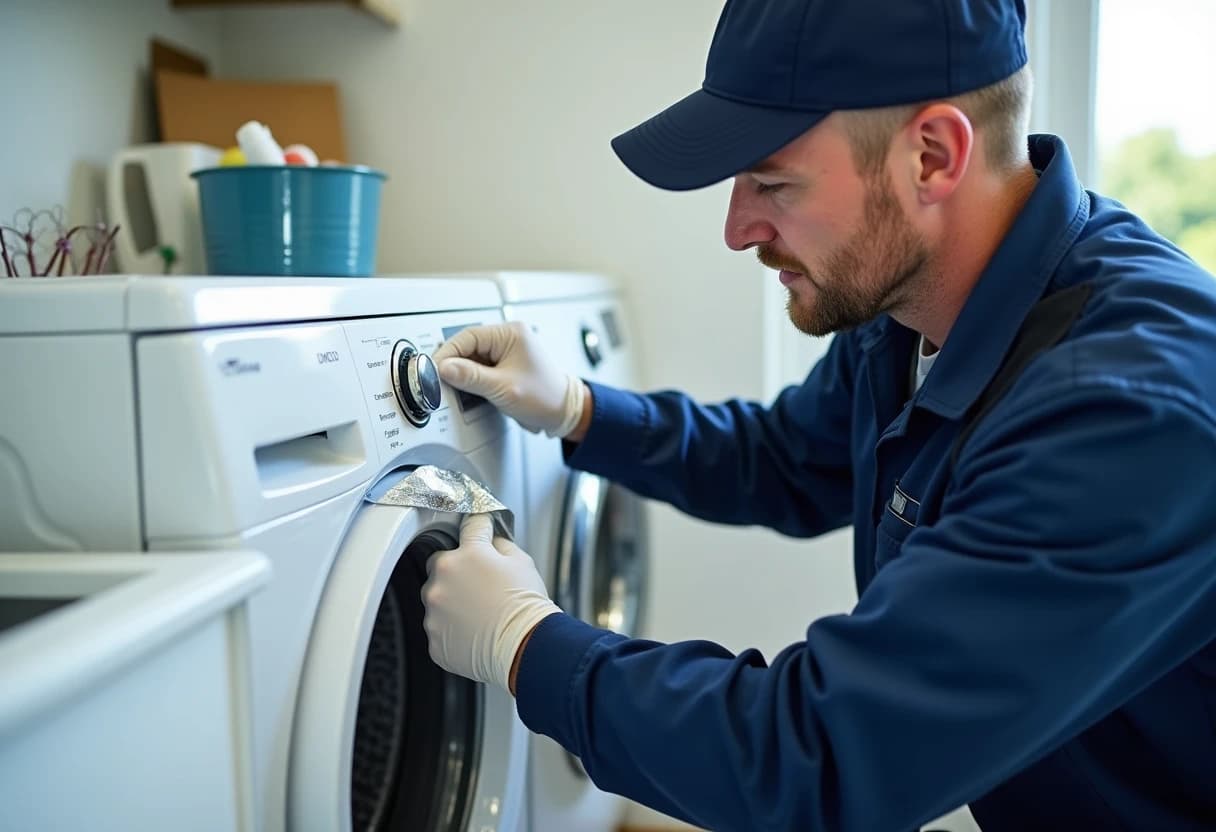
Homeowners in Bedford usually discover a broken dryer vent through a symptom that seems unrelated: a water stain on the ceiling under the laundry, lint appearing in the basement, a mildew smell in one wall, or an energy bill that crept up as the dryer strained. Our repair service finds the failure and fixes it for good — with 4-inch smooth rigid metal duct, joints fitted and clamped without airstream-piercing screws, seams sealed with UL-listed foil tape, and a new exterior hood where the old damper has failed. We are local, insured, and we photograph every repair so you can see exactly what was wrong and exactly what made it right.
Why Dryer Vent Repair Matters for Bedford Homes
A damaged dryer vent fails on three fronts at once, and all three get worse with every load. Safety first: a disconnection or breach releases lint — one of the most flammable materials in a home — into wall cavities, ceilings and basements, where it accumulates near framing with no way to remove it, while the restriction at the damage point drives up exhaust temperatures exactly the way fire investigators describe in the roughly 2,900 US dryer fires each year. Moisture second: every load pushes about a gallon of water vapor through the vent, and a leak delivers it into building materials instead of outdoors — wet insulation, mold-friendly wall cavities, stained ceilings, rotted subfloor around the laundry. Performance third: crushed and separated ducts strangle airflow, stretching drying times and energy bills while overheating the appliance. Cleaning cannot fix any of this; the duct itself is broken. A proper repair — rigid metal, sealed joints, verified airflow — resolves all three failure modes in a single visit, usually for $150 to $450.
A surprising share of our Bedford repair calls begin with a water stain. Bedford's core stock is 1950s and 60s capes, ranches and split-levels built during the Route 128 tech boom, ringed by newer executive colonials and townhouse condos near Great Road. Many of the mid-century homes have been expanded or gut-renovated by families drawn to the schools, so hybrid duct systems - original trunks feeding brand-new additions - are extremely common. A ceiling mark below a second-floor laundry, peeling paint behind a basement dryer, a mildew odor in one wall — homeowners call a painter or a plumber before anyone thinks of the dryer vent, yet a leaking or condensing vent is the cause remarkably often. Bedford's Route 128-era ranches are now sixty-plus years old, and their original sheet-metal ducts frequently show interior rust and blown fiberglass migration from aging insulation. With Hanscom Field next door, homes under the flight path also accumulate a fine gritty dust that residents notice on registers long before they call us. Our diagnostic visit settles it quickly: we trace the duct path, test airflow at both ends, and either confirm the vent as the culprit and quote the repair flat, or rule it out so you can chase the real source with confidence.
Our Dryer Vent Repair Process in Bedford
1Diagnose the Full Exhaust Path
Repair starts with finding every failure, not just the obvious one. We trace the duct from the dryer's outlet to the exterior termination, inspecting each accessible section and joint, and test airflow at both ends with the dryer running. Weak exterior flow with strong drum heat means the exhaust is escaping en route — and we find where.
2Protect the Area & Open Access
Access is half of dryer vent repair in older homes. We come prepared for ceiling-hung basement runs, duct concealed above suspended ceilings, and sections buried in soffits. Our aim is always the least invasive route to a proper repair — and clear communication before anything is opened.
3Reconnect & Properly Fasten Separated Joints
We do not just push a failed joint back together; we rebuild it so it cannot fail the same way. That means cleaning mating surfaces, correcting the misalignment or unsupported weight that pulled the joint apart, adding hangers or strapping where the run lacked support, and sealing the finished connection against both air and moisture leakage.
4Replace Crushed, Corroded or Non-Compliant Sections
Replacement is also the moment to correct design faults we find: a kink where two sections meet at a bad angle becomes a pair of smooth elbows; an unsupported span gets hangers; an oversized or undersized segment is brought back to uniform 4-inch diameter so airflow stops tumbling at transitions. We fix what failed and what made it fail.
5Cure Condensation: Slope, Seal & Insulate
Moisture-damaged components are replaced as part of the cure: corroded duct sections, rusted clamps, sodden insulation. We also check the termination damper, since a flap frozen or stuck partly shut is a common hidden cause of the backpressure that drives moist exhaust out through joints in the first place.
6Repair or Replace the Exterior Hood & Damper
Failed terminations get quality metal replacements: a hood sized to the 4-inch duct with a free-swinging damper that opens fully under airflow and closes tight against weather and pests. Screened hoods — a code violation on dryer vents because mesh mats over with lint — are replaced with proper damper-and-guard designs made for dryer exhaust.
7Replace the Transition Duct & Reset the Dryer
This step catches the last common failure point: many 'vent problems' are actually transition hoses flattened to a slot behind the machine. The compliant connector, correctly fitted and protected by proper dryer placement, ensures the airflow we restored in the wall actually reaches the duct from the appliance.
8Verify Airflow & Document the Repair
You receive photo documentation of the failures found and the repairs made — valuable for insurance files, condo associations, home sales and your own records. We also note the condition of everything we did not repair, so you have an honest picture of the vent's remaining lifespan and its next likely maintenance date.
Benefits of Professional Dryer Vent Repair in Bedford
Lower Energy and Repair Bills
A failed exterior damper is a hole in your heated envelope all winter — a 4-inch duct delivering January directly to your laundry room. Replacing it with a tight-closing hood pays for itself in heating savings and comfort, entirely apart from what it does for the dryer.
Moisture Out of Your Walls and Ceilings
Condensation repairs — slope, sealing, insulation — end the drip-and-pool cycle that rusts ducts from the inside and stains ceilings from above. Laundry areas dry out, winter window condensation eases, and the musty smell that clung to the wall behind the dryer leaves with the moisture feeding it.
Code Compliance & Inspection-Ready Documentation
Compliance is not paperwork for its own sake; each code provision encodes a failure the industry learned about the hard way. Smooth interiors resist lint. Clamped joints survive heat. Unscreened dampers do not mat over. A to-code vent is simply a vent engineered not to fail the common ways.
A Serious Fire Hazard, Eliminated
Lint inside a wall cavity cannot be cleaned on any schedule; the only fix is stopping the leak that puts it there. Repairing disconnections and sealing joints confines lint to the duct, where annual cleaning can manage it. That containment is the difference between a maintainable system and a slowly growing hazard you cannot see.
Restored Drying Performance
Customers are often startled by the change: a vent we repaired after years of gradual crushing gives them back the dryer they bought. If your drying times worsened after an appliance delivery, a renovation, or a move of the machine — events that crush transitions and separate joints — repair, not replacement, is very likely the answer.
Pest Entry Points Closed
Pest damage rarely stays at the hood: rodents that enter a duct chew insulation and nest against warm sections deep in the run. Closing the entry point promptly is far cheaper than the extended cleaning and repair an established rodent presence demands — one more reason failing dampers deserve fast attention.
Signs Your Bedford Home Needs Dryer Vent Repair
A Home Inspection or Appliance Tech Flagged the Vent
When an appliance technician condemns your vent while servicing the dryer, believe them: they have just measured the backpressure your machine fights on every load. Repairing the duct protects the repair they made — a new heating element or thermal fuse installed against a failed vent will simply fail again.
Water Stains, Drips or Peeling Paint Near the Vent Path
A ceiling stain below a second-floor laundry, paint bubbling behind the dryer, or drips from a basement duct joint all point to exhaust moisture escaping or condensing in the run. Each load adds another gallon of vapor to the problem. Repair — sealing, sloping, insulating or replacing the affected section — stops the source; cosmetic fixes without it just repaint the symptom.
Lint Appearing Where It Shouldn't
Lint drifting from a basement ceiling, gathering on joists, puffing from a wall register or collecting behind the dryer means exhaust is escaping the duct before the termination. Lint marks the leak like dye in water — follow it and you find the separated joint or breach. This is a repair call, not a cleaning call, and it should not wait.
Visibly Damaged, Kinked or Sagging Duct
Sag matters more than it looks: a bellied section pools condensate, which soaks lint into a mat, which adds weight, which deepens the sag. The cycle ends in a blocked or rusted-through low point. Adding proper support and restoring slope while the duct is still sound is a small repair that prevents a large one.
Musty or Mildew Smell in the Laundry Area
A persistent damp smell around the laundry — or in one adjacent wall or ceiling — often means exhaust moisture has been feeding hidden mildew via a leak or chronic condensation. The odor is the nose's report on a moisture problem the eyes cannot see. A vent-path inspection locates the escape point, and repair dries up its food supply.
Exterior Damper Broken, Stuck or Missing
Look at the hood outside: a damper flap hanging loose, rusted stiff, cracked off, painted shut or missing entirely is a failed termination. Stuck open, it drains heat and admits pests all winter; stuck shut, it blocks the vent completely. Either way the fix is a proper replacement hood — one of the fastest, most cost-effective repairs on our list.
Dryer Vent Repair Cost in Bedford, MA
It helps to know what drives repair pricing, because the failure type matters more than the home's size. Accessibility is the biggest factor: a joint hanging exposed in a basement is a fast fix, while the same failure above a finished ceiling involves careful access and restoration planning. Materials are second: quality rigid metal duct, UL-listed connectors, foil tape and a solid termination hood carry real parts costs — roughly $30 to $120 of most invoices — but they are why the repair lasts decades. Scope is third: many vents present multiple failures at once (a crushed transition and a failed damper and a leaking joint), and bundling them into one visit is significantly cheaper than three separate calls. What does not drive our pricing: drama. We quote from the diagnosis, show you the photos, and price the fix flat. Massachusetts homeowners have seen enough scare-based selling around dryer fires; the facts are alarming enough without embellishment, and the honest repair is usually a few hundred dollars.
Want the full pricing picture? See our complete Boston-area cost guide or call (617) 390-7145 for an exact flat quote for your Bedford home.
Local Knowledge: Bedford, Middlesex County
Every town's ductwork tells the story of its housing. Bedford's core stock is 1950s and 60s capes, ranches and split-levels built during the Route 128 tech boom, ringed by newer executive colonials and townhouse condos near Great Road. Many of the mid-century homes have been expanded or gut-renovated by families drawn to the schools, so hybrid duct systems - original trunks feeding brand-new additions - are extremely common. Bedford's Route 128-era ranches are now sixty-plus years old, and their original sheet-metal ducts frequently show interior rust and blown fiberglass migration from aging insulation. With Hanscom Field next door, homes under the flight path also accumulate a fine gritty dust that residents notice on registers long before they call us. We plan Bedford jobs around those realities, from equipment selection to time on site, and it shows in the results. If you live near Hanscom Field or anywhere across Bedford's 01730 area, we have almost certainly cleaned a system like yours before — and we can tell you exactly what to expect before we arrive.
The Best Time of Year in Bedford
The freeze-thaw cycle is uniquely hard on the exterior components of New England dryer vents. Damper hinges and springs work loose as metal expands and contracts; caulk joints between hood and siding crack open, letting wind-driven rain into the wall; and ice forming in the hood from condensing exhaust bends flaps out of true a little more each season. Coastal and near-coastal homes add salt corrosion, which seizes hinges and eats galvanized steel years ahead of schedule. This is why we treat termination inspection as part of every service call: the hood fails gradually, then suddenly, and replacing it during a routine visit costs a fraction of the cascade — drafts, pests, blockage — that a failed one begins.
Why Choose Boston Air Duct Cleaners
As a West Newton-based company, we treat Bedford like the neighborhood it is — because for us, it is. Our reputation lives or dies on local referrals, so every job gets the full process: complete system cleaning under negative pressure, mechanical agitation of every run, blower compartment service, and a documented walkthrough before we leave. We are licensed and insured, our estimates are free and flat, and our schedule holds same-day slots for urgent calls. One visit and you will understand why neighbors keep our magnet on the fridge.
Serving Bedford and Surrounding Communities
We serve every community around Bedford as well: Lexington, Concord, Burlington, Billerica, Carlisle, Lincoln all fall inside our regular service routes. If you have a second property, a rental, or family nearby, ask about multi-home scheduling — grouped appointments on the same route are our most requested discount.