
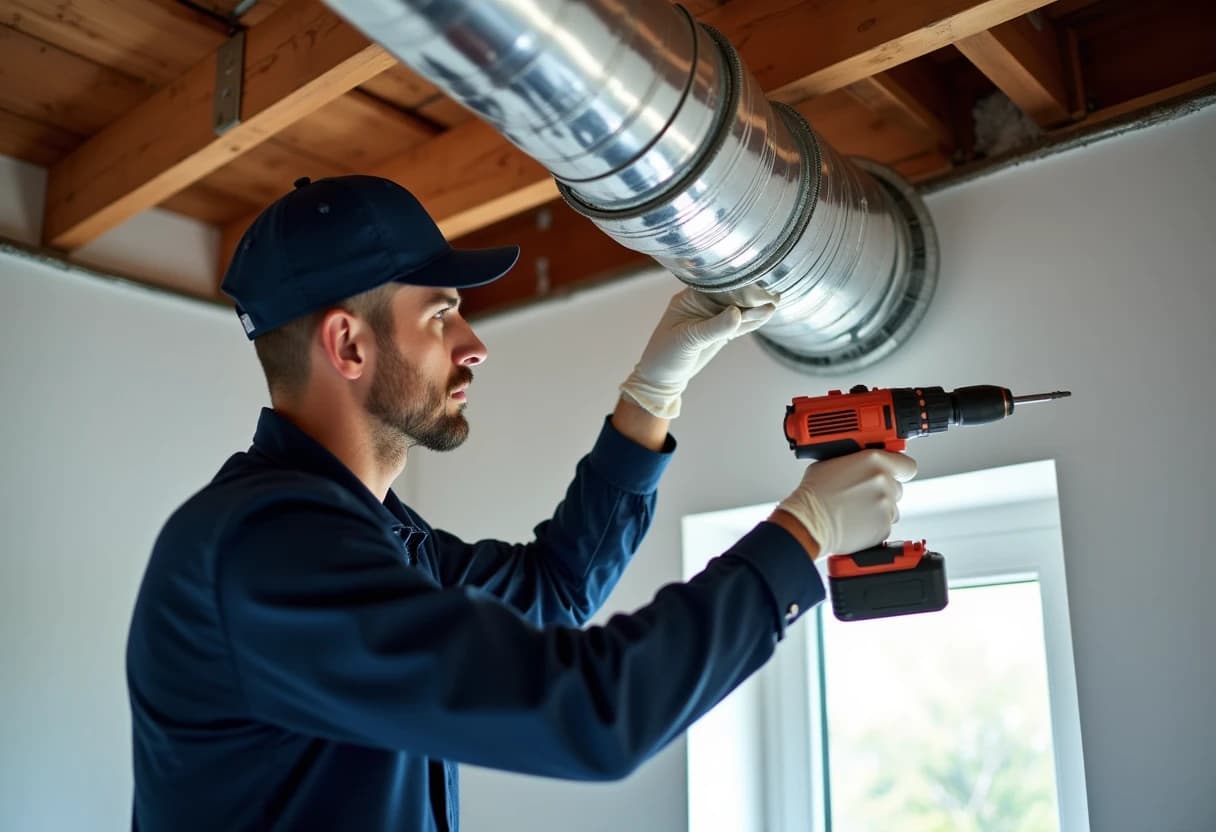
An overlong dryer vent is a permanent tax on every load of laundry. Each foot of duct and every elbow adds resistance; the code caps the total at 35 equivalent feet — with each 90-degree elbow typically counting as five feet — because beyond that, dryers simply cannot push lint and moisture to the outlet. Yet Greater Boston basements are full of runs half again that long, snaking around decades of renovations. Our rerouting service shortens them: we find the nearest legal path outdoors, often cutting a 40-foot wander to a 12-foot straight shot, and rebuild it in rigid metal. Drying times drop immediately, lint accumulation slows permanently, and the fire-risk math improves for good.
Why Dryer Vent Installation & Rerouting Matters for Back Bay Homes
New England's housing stock makes professional installation more consequential here than almost anywhere. Triple-deckers and brownstone conversions put laundry deep in floor plans, far from legal termination points, demanding careful route planning against the length budget. Balloon-framed Victorians hide cavities that swallow flex duct into inaccessible, uncleanable runs. Stone and brick foundations require masonry penetrations done with the right tools and flashing. Retrofitted basement laundries sit below grade, where the only paths out are up through the rim joist or across to a window bay — and where cold foundation walls make uninsulated duct a condensation machine. Condo associations layer approval processes and insurance requirements on top. We work these constraints every week: our installers carry the drills, core bits, flashing and fittings the old construction demands, we insulate runs crossing unheated space as a standard practice, and we provide the certificates and documentation associations require. The result is a vent that fits the building it serves — not a catalog diagram forced into a house that predates the catalog by a century.
Condo and multi-family installation around Trinity Church is its own discipline, and Back Bay associations know the stakes: one bad vent in a shared structure is everyone's fire risk. Back Bay is a nearly unbroken grid of Victorian brownstones built on filled land between the 1860s and 1890s, most long since divided into condos, alongside luxury towers near the Prudential and Copley Place. Original coal-and-radiator buildings have been retrofitted over and over - high-velocity mini-duct systems, ceiling-cassette air handlers, and full forced-air conversions threaded through plaster walls and marble-trimmed stairwells. Those retrofit runs are narrow, joint-heavy and notoriously dusty. We manage the full process — written scopes for board approval, certificates of insurance, penetrations planned with the building envelope and neighboring units in mind, and per-unit documentation on completion. The high-velocity small-duct systems common in Back Bay brownstones clog faster than conventional ductwork because the two-inch flexible tubing has so little tolerance for buildup. Add in landmark-district window restrictions that limit natural ventilation and dryer vents that exit through rear alley walls after long horizontal runs, and Back Bay units benefit from cleaning more often than almost anywhere we serve. For triple-deckers and small associations we can rough in venting for multiple units in one mobilization, which cuts per-unit cost substantially and gives the building one consistent, compliant system.
Our Dryer Vent Installation & Rerouting Process in Back Bay
1Site Assessment & Route Planning
Planning is where installations succeed or fail, so we do it deliberately: equivalent-length math on paper, termination clearances checked against grade, snow line, openings and property conditions, and the penetration point chosen for both duct efficiency and envelope integrity. For renovations, we are glad to plan while walls are open — the cheapest routing decisions are made before drywall.
2Demolition of Non-Compliant Venting
Replacement jobs start with removing what failed: vinyl and foil flex pulled from cavities and joist bays, abandoned duct capped or extracted, screened hoods and window inserts taken out, and improvised terminations into attics or crawlspaces closed off. We vacuum the lint these systems have shed along their routes — hidden accumulation that should not stay in the structure.
3Cut & Flash the Exterior Penetration
Penetrations are where amateur installs leak — water into sheathing, air into cavities. Ours are built like window details: sized to the hood, flashed to shed water over the cladding, sealed with quality exterior sealant, and finished so the termination looks intentional on the facade. On masonry we drill and anchor; we never improvise attachment.
4Install Rigid Metal Duct on the Planned Route
Where the route crosses unheated space — a cold basement, garage bay, attic run — we insulate the duct so exhaust stays above its dew point until it exits, which is the difference between a dry duct and a condensation problem in a Massachusetts winter. Concealed sections are completed and verified before any finishes close them in.
5Mount the Termination Hood & Damper
Termination choice is matched to the route: low-profile wall hoods for clapboard and shingle, masonry-mounted hoods for brick, rim-joist hoods for basement exits, and dedicated dryer roof caps — never plumbing-style caps — for vertical runs. Each is chosen for damper quality, because the damper is the moving part that determines how the termination survives New England weather.
6Connect the Appliance & Seal the System
System sealing is completed end to end: every joint taped with UL-listed foil tape, the wall penetration sealed inside and out, and the transition clamped tight. A dryer vent is a pressure system; leaks anywhere cost airflow at the termination and push lint and moisture into places they do not belong. Sealed means sealed everywhere.
7Test, Verify & Document the Installation
Before we leave: work areas vacuumed with HEPA equipment, penetration debris removed, the dryer set and leveled, and a walkthrough of the finished system — where it runs, how the damper should look during a cycle, and when the first annual cleaning is due. A correctly built vent needs almost nothing from you; we make sure you know the little it does.
Benefits of Professional Dryer Vent Installation & Rerouting in Back Bay
Decades of Service From a One-Day Job
Rigid metal duct, properly supported and sealed, is lifetime infrastructure: it does not kink, sag, melt or degrade, and it routinely outlasts several dryers. After installation day, the system's entire maintenance schedule is an annual cleaning and an occasional glance at the damper. Most homeowners never think about it again — which is the point.
Permanently Lower Energy Costs
A dryer that finishes in one cycle instead of two uses half the energy per load — a difference worth $10 to $20 a month to a busy household, recurring for the life of the system. Few building improvements have a payback mechanism this direct: the installation cost is fixed once, and the savings arrive with every laundry day after.
A Laundry Located Where You Actually Want It
Proper vent design frees the floor plan: a second-floor laundry, a kitchen-adjacent closet, a finished-basement corner all become viable when the exhaust route is engineered rather than improvised. We tell you honestly which locations work within the length budget — and often find compliant routes that make the layout you wanted possible.
Code Compliance That Closes Every Question
The finished system meets the IRC's dryer exhaust provisions line by line: 4-inch smooth rigid metal, equivalent length within the 35-foot budget, no fasteners in the airstream, damper-equipped unscreened termination. For home sales, that removes a standard inspection flag; for permits and condo approvals, our documentation answers the questions before they are asked.
Fire-Safe by Design, Not by Vigilance
Roughly 2,900 US home dryer fires a year trace overwhelmingly to lint, and lint traces to the installation faults a proper build eliminates: flex corrugations, overlong runs, obstructed airstreams. Replacing an improvised vent with an engineered one is the single largest permanent reduction in dryer fire risk available to a homeowner.
Dramatically Faster Drying
Shortening a wandering 40-foot run to a direct 12-foot route transforms drying performance: full airflow means each cycle actually exhausts the gallon of moisture a load releases, so sensor dryers stop running overtime and heavy loads finish in one pass. Customers routinely describe post-installation performance as having bought a new machine.
Signs Your Back Bay Home Needs Dryer Vent Installation & Rerouting
Your Vent Is Flexible Plastic or Foil Duct
Flex duct concealed in walls and cavities is the worst case: it cannot be effectively brushed, so no cleaning ever truly clears it, and it accumulates lint until it blocks. If a cleaning service has ever told you your run 'can't really be cleaned,' this is what they meant — and rigid replacement is the answer.
Chronic Condensation the Route Guarantees
Some vents condense because of damage; others condense because of design — long uninsulated passages through cold basements, garages or attics where exhaust cannot stay above its dew point, or bellied routes with no slope to drain. When repair visits keep treating water in the same duct, the route is the diagnosis, and rerouting or rebuilt insulation and slope is the cure.
The Dryer Vents Indoors — Anywhere
Window inserts and condensation boxes marketed as 'indoor dryer vents' are not a solution for a standard vented dryer in a Massachusetts home; they are humidity machines. If one is in service in your laundry, a proper exterior route almost certainly exists — our assessment will find the shortest one and price it flat.
A New Laundry Location Needs Its First Vent
Moving laundry upstairs, finishing a basement, building an in-law suite or converting a condo all create the same requirement: a new exhaust route, designed before the walls close if at all possible. Vent routing decided at the framing stage is shorter, cheaper and cleaner than the same route retrofitted through finished surfaces months later.
Inspection, Insurance or Association Requirements
Massachusetts home inspections flag improvised dryer venting constantly — flex runs, screened hoods, indoor terminations, overlong routes — and the flag follows the transaction: buyers demand fixes, sellers concede credits. A documented compliant installation clears the item permanently, whether you are listing this spring or just retiring a known liability.
The Run Is Overlong or Elbow-Heavy
The symptom pattern of an overlong run: drying times that were never good, cleanings that help briefly and fade fast, and lint accumulating mid-run rather than at the ends. No maintenance schedule fixes a route that exceeds the appliance's reach; rerouting to a shorter path is the only durable answer.
Dryer Vent Installation & Rerouting Cost in Back Bay, MA
Understanding the cost drivers helps you compare quotes intelligently. Distance and elbows set the duct budget — both in dollars and in the code's 35-foot equivalent-length allowance — so the shortest workable route is cheapest twice over. The penetration is the next driver: hole-sawing clapboard is quick; core-drilling stone foundation or flashing a roof cap takes equipment and time. Access is third: exposed basement routes install fast, while runs concealed through finished walls and ceilings involve careful openings and coordination on restoration. Termination choice matters modestly — quality wall hoods, rim-joist hoods and dryer-rated roof caps span roughly $30 to $150 in parts — but skimping there is false economy, since the damper is the system's one wear component. Beware quotes that reach a low number with flex duct, screened hoods or screwed joints: each is a code violation that converts your installation savings into years of accelerated lint accumulation and future service calls. The correct comparison is rigid-to-rigid, and on that basis our pricing is consistently competitive across Eastern Massachusetts.
Want the full pricing picture? See our complete Boston-area cost guide or call (617) 390-7145 for an exact flat quote for your Back Bay home.
Local Knowledge: Back Bay, Suffolk County
Serving Back Bay means knowing Back Bay. Back Bay is a nearly unbroken grid of Victorian brownstones built on filled land between the 1860s and 1890s, most long since divided into condos, alongside luxury towers near the Prudential and Copley Place. Original coal-and-radiator buildings have been retrofitted over and over - high-velocity mini-duct systems, ceiling-cassette air handlers, and full forced-air conversions threaded through plaster walls and marble-trimmed stairwells. Those retrofit runs are narrow, joint-heavy and notoriously dusty. The high-velocity small-duct systems common in Back Bay brownstones clog faster than conventional ductwork because the two-inch flexible tubing has so little tolerance for buildup. Add in landmark-district window restrictions that limit natural ventilation and dryer vents that exit through rear alley walls after long horizontal runs, and Back Bay units benefit from cleaning more often than almost anywhere we serve. Those conditions shape how we work here: which brush heads come off the truck, how we protect finishes in older interiors, and what we expect to find when the camera goes into a 02116 duct system. Our crews are in and around Back Bay nearly every week — often for neighbors of past customers — so scheduling is fast and our arrival windows hold.
The Best Time of Year in Back Bay
Humid summers argue for good vent design from the opposite direction. When dew points sit in the seventies, dryer exhaust barely cools before reaching saturation, and any route flaw — a belly, a leak, an oversized dead-air section — collects water through the muggy months while basement laundries add ambient humidity of their own. Summer is also when improvised indoor venting does its worst damage, loading attics and crawlspaces with moisture exactly when the structure cannot dry. And at the termination, summer is nesting season: hoods without proper dampers and guards acquire tenants between March and June. A properly designed system shrugs all of it off — sealed, sloped, insulated, guarded — which is why summer's symptoms are so often what finally send homeowners to the phone.
Why Choose Boston Air Duct Cleaners
As a West Newton-based company, we treat Back Bay like the neighborhood it is — because for us, it is. Our reputation lives or dies on local referrals, so every job gets the full process: complete system cleaning under negative pressure, mechanical agitation of every run, blower compartment service, and a documented walkthrough before we leave. We are licensed and insured, our estimates are free and flat, and our schedule holds same-day slots for urgent calls. One visit and you will understand why neighbors keep our magnet on the fridge.
Serving Back Bay and Surrounding Communities
Beyond Back Bay, our crews cover the surrounding communities daily — including Beacon Hill, South End, Boston, Brookline, Seaport District, Allston. Because routes cluster geographically, booking alongside a neighboring appointment often unlocks same-day service and combined-visit savings. Wherever you are in Suffolk County, the same flat-rate pricing, insured technicians and photo-documented process applies.